|
| Send it by clicking on the Pence Dojo Icon |
|
To ALL Martial Artist, Members or NOT You
are welcome to submit your Martial Arts Articles for publishing on this Site. Send it by clicking on the PSD Icon.
The idea is to help your fellow Practitioners so that the Student becomes more skilled than the Master.
"No matter what art you are from, we are all brothers and sisters when we are
students of the Arts"
Kevin Pence Sr.
 How does one set out to
name a form of martial art? First there is no new technique but only different variations of ones already out there. Having
said that, some would say realistically people do this sort of thing.... First
they Master one established martial art system and be recognized as having done so by authorized teachers of that system.
After mastering other systems try to re-evaluate everything that they learned through a particular lens. Kano used physical
efficiency and safety of practice as the lens for judging the ju jutsu he mastered to codify Judo. Although Kano promoted
judo whenever he could, he earned his living as an educator in the Japanese school system. Usheuba of the art Aikido used a lens towards non-violent, minimally destructive methods of countering. The Gracie’s
used leverage methods requiring minimal strength to produce his family Ju-jitsu. Find
what it is that you think needs to be emphasized, how you're capable of doing this and then set out to see if your lens
works at making training better and distinct from what you learned from your master.
Then you need a proving ground for
what you are about to embark upon, as well as good people to help as would-be attackers, ones who have martial skills in multi-art
systems, military and police officers are also good ukes. Then take what you've
re-made and then present it to those who studied your previous styles and then to the world. If you stand the test of challenge
and, have a coherent set of reasons for why you've made the changes you have and added what you have, you're well
on your way towards effectively making a different art.
Or you can skip all this hard work and long hours of writing
and re writing your syllabus, buy a black belt belt from an online dealer, whip ten stripes of red tape on it and, write up
a load of diplomas and proclaim yourself grandmaster king of all you survey. Don't laugh its been done
  The "Biz" of owning a Martial Arts
School There are two
kinds of schools.... The first, although
there are dues, teaching martial arts is not the instructor's "day job". The chief Inst. has
other forms of employment, the instructor's regular job somewhere else is what makes his house, health care, and
car payments. In these dojos,
student dues are used to pay the rent, utilities and some ad cost. In other instances, the instructor rents space
from YMCA or a health/fitness club, and student fees pay the for that space. But no matter how you say
it, the instructor isn't making his living from teaching the arts. These kinds of schools tend to be described as " a labor of love." The people
involved do it because they love the arts, and teaching them. Such instructors are less likly to be concerned with keeping
the students happy with the a new rank, than making sure those students "are the best they can be." so... in
most case the quality tends to be better in these Academies. The other kind of martial art dojo is what we refer to as a "commercial school." The
teacher is not only making the school's rent and utilities, but his own expenses. Now the dojo has to produce enough
profit to support the instructor and his family morgage, insurance, food, car payments etc., And the only way to do this is
to keep the enrollment up. Aside from the cash
cows of contracts, there are many ways such schools generate revenue. This ranges from, enrollment fees, required uniforms,
specialized equipment "extra" workshops that you must pay for, and fund raisers. There are often DVDs of the
system, available through the school's supply store. While smaller schools are often run by the sole owner. Franchise dojo, ( a.k.a.. A.T.A. U.S.S.D.
ect.) are schools that must pay fees to the franchising organization. Organizational memberships, hosting the head instructor
for seminars, etc. these are some of the countless ways that money flows from "satellite schools" back to the
central Org.. The requirement to keep the main association fed also requires the student numbers be kept up in satellite. If
a school shares the name with a larger organization, then it is probably a franchise. To the new student I say this; look around, go to the schools ask questions...
alot of questions. In the end it's the the relationship between student and teach that is most important for learning
the martial arts and not the "big biz".
Are you trainning or just going to class?
My own training has enriched every part of my life... from my work,
my to interpersonal relationships. In my opinion, this is the thing that makes a martial artist as opposed to someone
that practices martial arts. I hope that none of us ever need any of what
we study. Fighting is a nasty business, too often glorified. But the truth of the matter is that in today’s world
there is a need for the ability to protect ourselves.
The Arts do have a stigma about them. One conjures images of warriors
with bowed heads and blades, all living by a code of honor, of discipline, humility,and loyalty.
Respect the dojo and trian hard. That is all I ever ask. Our
dojo is it’s a lot more relaxed than most. I don’t care about anyone’s rank, because rank is not everything,
trust me.
I do care about students that get into the wrong school
. It makes all the arts get a bad name.
If you are
in a school where you feel the teacher is not teaching you .... don't stay just to say you have loyalty . If you are wondering
whether or not a particular school is legitimate one well... we live in an age where the Internet is an open door for us to
expose a fake. Don't wonder what if, find out for yourself!
Think. Save yourself

Clean, Lean, fighting machine! I don't think cleaning the dojo is part of training. It is however, part of being a productive member
of the dojo. I spent many years helping to clean my Masters dojo before training and after. Never once did I consider
it beneath me or kissing butt. It was simply part of the package of being a good student - since I did have an emotional
commitment to the art and the dojo, I felt it was my duty. If a new student walked
in to the dojo I wanted them to see it at its best. In our dojo my best students participate fully in the cleaning..(sweep, vacuum, wash, picking-up,
building, whatever ) without ever being ask. I don't think I have ever asked anyone to do something I wouldn't
do that very moment myself.
I don't ever think that having students clean a dojo is part of "martial"
training for them. It is simply something else that they do and is in their "job description" as students. I can
imagine how some would use cleaning as a way of humbling students, but that has never been my experience. I would hope that
my students would naturally want to help. Again, I don't think it's part of training, but it is part of being part
of the club. Cleaning the dojo is so much like community service, you volunteer your service as part of a collective
whole, you are in for a greater good - e.g. no smelly dojo. It's all about opportunities.
If you see one take it! Some time you may hear me say to the Jr. Students;
"We have a special guest coming today, make sure the dojo looks nice." That's my way of saying you never know
who will walk in the door, at anytime.
As martial artist must always strive to apply themselves. The idea of cleaning the dojo is to be socially mindfull
and to take care of the place where you do most of your intensive training. It shows respect to the space where you learn
and it teaches one to apply themselves even in the most seemingly mundane of activities.
"I used to be a black belt" Over the years I have tried
to help many people from other arts, and some of those students haven't always had the most noble of reasons for training
with me. Some have left their past teachers in the way any man should be relived of duty. For
your rank to be honored in my dojo I ask that the student wear no belt for a period of time as a small test to see if that
is the only reason they are back in the art. I give my art to those who are worthy because that is my way. If you come to
this dojo and claim prior Dan Rank, you must have a letter of introduction from your last or first Master or we will not be
able to help you. You don't owe anything to us... and we don't owe you anything including admission to our program.
Your tuition just keeps the lights, heat, and phone on. You will always owe a debt to your First Teacher or the one who gave
you the birth of your first Dan ranking, because you represent him or her, from then until the end of your time... Like it
or not! "So don't lie and don't run, just live, love and have fun"....
Train, train and then train some more". kp Sensei
"Being the Uke"
Being the uke (ouh key) means just that . Being the dummy or
model for a thought, it is not a fight!
Feeling any given Tech. is always better than seeing it or doing it
to the air. Taking a hands-on approach might be the wisest move you can make in the dojo.
However, playing your way out of a lock or trap may sometimes
get you hurt. Be sure that the training partner knows what you are doing so that he or she does not jerk, twist, slip, or
fall on you or hurt himself in any way. Save the quick jerk and snap for the street.
Remember that in most cases you have had the first blow or two
to wound you.. could you still perform that same move with out the use of that leg, or that hand?
Be a thinker even when you are the "uke" just know your place
at that time is for the other person. Not just for you to feel the
postion you would be in, but for him to feel your postion. In this case as a uke "think it, but don't do it! ...... NO NIKE aka ("just do it")
Remember the saying about too many cooks and what they did to
the broth? Keep this all in mind if you get an urge to peek and stir, but always feel free to taste, when the broth is done.
This is to say know the Combo well before you begin to tweak and bend it or make it your own.
While I share my art with all of my students ....my art is mine
and yours is yours. You need to work so that the base of the tech. stays pure, but that you are comfortable with the
out come .
In deciding to lend a hand to someone in need, you actually
end up helping yourself by discovering a new path. In fact, rather than feeling put upon or exhausted by another's demands,
you find yourself rising to challenge. It helps you that you get to use the best of yourself in aiding this person.... your
diplomacy, tact, and thought all come in handy when trying to persuade the "powers that be" (gravity) to see things
another way!
K.P. Sr. Sensei
| LAST CHANCE! |

|
| TIME IS RUNNING OUT !!!! BLA, BLA ,BLA, |
Concepts NOT Con's
Which art is better is the question I get from non-martial
artist and martial artist alike. Is Karate, is it Ju Jitsu, Judo, Kali or maybe Hung gar? The real and only answer is, all
of them are the best when you take what you need from each art. This is not to say run out and train 6 Mo. in each art but,
rather to seek the knowledge that each art holds at its base. What are the arts under lying concepts? Its thoughts on
line of attack, its level on soft vs. hard, does the art work from the ground? These in my eyes, are the right questions.
This is what we should study as students of the arts!
The concepts of Form, Kata, & Ping-te's in The art of
San Chai Na Kempo; for example, are only important because it gives us a Great base to learn from. The techniques of
the "true Way" change constantly, every encounter is unique, and the appropriate response should happen naturally. Do
not get caught up with the form and appearance of techniques.
In your training do not be in a hurry to get to black
belt or even the next deg. of black. It takes years to master just the basics. Never think of yourself as an all-knowing,
Leave all of this to the self proclaimed grandmasters of the Universe. You must continue to train daily with your friends,
students, Peers and Seniors and progress together in the Arts .
This is the secret of the "Way of a Warrior". Ready.........
Progress comes to those who train and train hard. Reliance
on secret techniques will get us nowhere. Today's techniques will be different tomorrow and then again on Monday and so on.
While the combo's and kata I teach everyday stay true to form, the amount that they are left to bend..... is limitless!
KNOW THIS
K. P. Sr. Sensei
3 P’s?
What are the Practice, Practice, and more Practice
The Martial arts demands intelligence but also, practice, practice, and then when your done more practice
is the base that makes it all work . The 3 P's eventually reveals some basic truths. The rewards are immense for those who
try hard, and have a patient respect for the arts.
Teachers can only lead the way down the path you are taking. When you are lucky enough to develop trust
in a good mentor , you can avoid many obstacles, dead ends and explore more avenues of the arts. I want my students to think
for themselves. The student that learns to think and analyze at length but also learns when to let go, to react when necessary
rather than decide, is the best of all.
A quality dojo is one in which everyone who is open to the instruction can participate beginner, intermediate,
or advanced level . There is so much to learn that many will be overwhelmed if they are looking for the quick fix of "make
me a black belt next week or I'll quit" I say to these folks "There's a school not so far away from here, I'll call the Master
for you". They do not have the most important aspect of being a real Student... a teacher that calls them a true student.
It is the most important title in the arts.
Be patient but also practice, practice, and then when your done, more practice. It ‘s that simple.

Grand (Masters) ideas!
Unfortunately hostility and childlike behavior are
some of the parts that go to making up the whole picture of the "Martial Arts Biz". Desire to be on the top of the mountain
is another. There are Lots of groups, clans, or styles.... each with its own spin on history and lineage and who really is
the "king of the hill."
This on going business of trash talking the old Masters
is bull! " I have nothing against
you personally, it is only business" .....IS DEEPER BULL ! Didn't Mom ever tell you if you don't have anything nice to say
then don't say anything at all ! What is past is past.
Putting that aside and getting together for memorable
events are whats important to the Martial Arts now. If there are bad business deals in the history of some of the clans, they
should learn from that and move on. Every time a master says something about another master (old or young) it sets
an awfully bad example for all students. We all look foolish.
Humility and not allowing
ego to get in the way of doing what is right is the Martial way....right ? . The martial arts is about bringing people
together , or should be.... Right?
If all the "Grandmasters"
of each one of the clans would get together and check their egos at the door, maybe we could have a sharing of ideas between
all. Just because there were issues in the past doesn't mean you can't get past those and move on for all to benefit.
Rank aside, each clan has its own"Head master"
and no one person will ever pull them back under one System , Org. or Federation.... who wants to anyway?! I still
believe it is possible to share knowledge across different systems .. I've seen it happen right here in New England.
None
the less it is still getting together and meeting with our martial Brothers and Sisters that is important now, because who
knows about tomorrowand what will happen!
We all look stupid when the masters bicker... It is hard to fly Even with two
eyes, so lets not pluck each others out over nothing! Please save the fights for the street!
Mr. Will I. Am
"Finally a White belt, after a lifetime of training"

 Kali
I am but one of many to discover a modern use for the
ancient arts of the Philippines. An art deemed so dangerous by the Spaniards they banned it for 400 plus years.
Kali, more commonly known as Arnis, and Escrima, the Filipino martial arts have a long history of secrecy.
The Filipino
arts are some of the best suited for real life self defense. Used by
Filipino warriors for centuries to defend themselves from foreign enemies, the warrior arts are a tradition of the culture.
Before Spain's rule over the Philippines, the Filipino people had been perfecting sword fighting. It was not until the
death of Portuguese explorer Magellan ( 1480 -1521 ) at the hands of the Filipino warrior that the world got its first glimpse
of this deadly art. As a result, the Spaniards banned the practice of the earliest form of the ancient art, from the
entire archipelago for four centries. But the art survived as Filipinos continued to practice Kali in secret. Today
in the USA we have had a real surge in new students of the arts of Kali, mostly because of its reputation in the use and defense
of the the blade. Blades short or long, Kali has the years of experiance to deal with the best of the other traditional
martial arts on the U.S. market today.
Get Sticky not Stuck
Traning in the stick arts is not always what it may seem , I think many
people are shocked to here that most Kali systems are meant for the use of the blade but, most use the baston to train w/
for safety purposes.
Both old and modern practitioners of the arts realized
that they will possibly face the Katana or today the machette, and thus we as they should have defenses specifically
designed to defend against these weapons.
The practitioner of old learned to use all the weapons that
he might have to face. So while we do learn how to use egded weapons in our
dojo it is also to learn how it may be used to hurt us. For to know the
weapon, is to also know it's weaknesses.
When ever possible we would like to take the weapon away from
the attacker . It could be said that you can never trust a man with a knife in his hand after he has tried to cut you
but, the truth is, it is easier to aviod the cut and do your work as a striker frist and then when possible disarm.
This is to say that we should not just expect to simply trap his blade hand and strip it away , it takes some distraction
frist and alot of training.....alot of training!
kp sensei
|
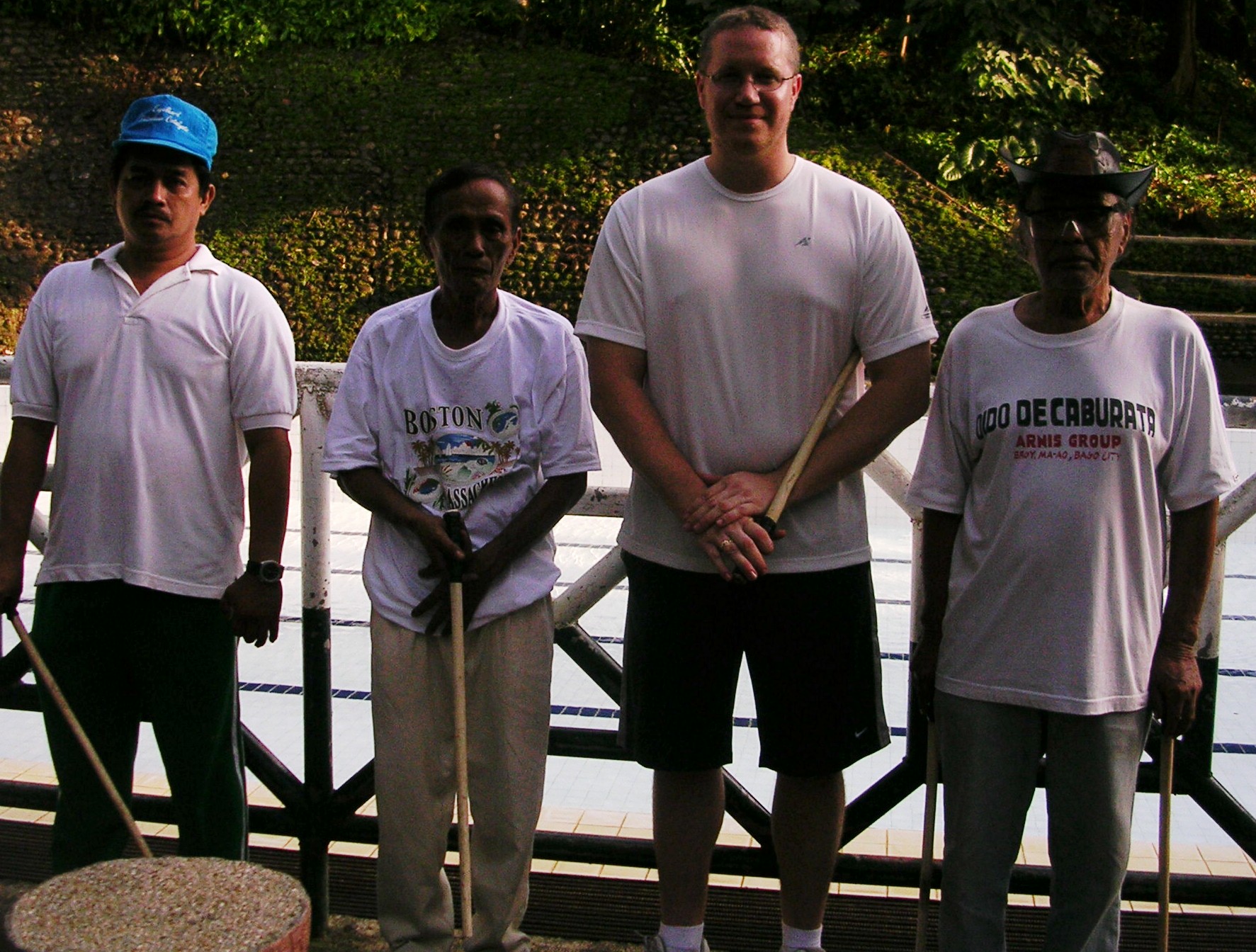
| Oido De Caburate with Sensei Pence |
 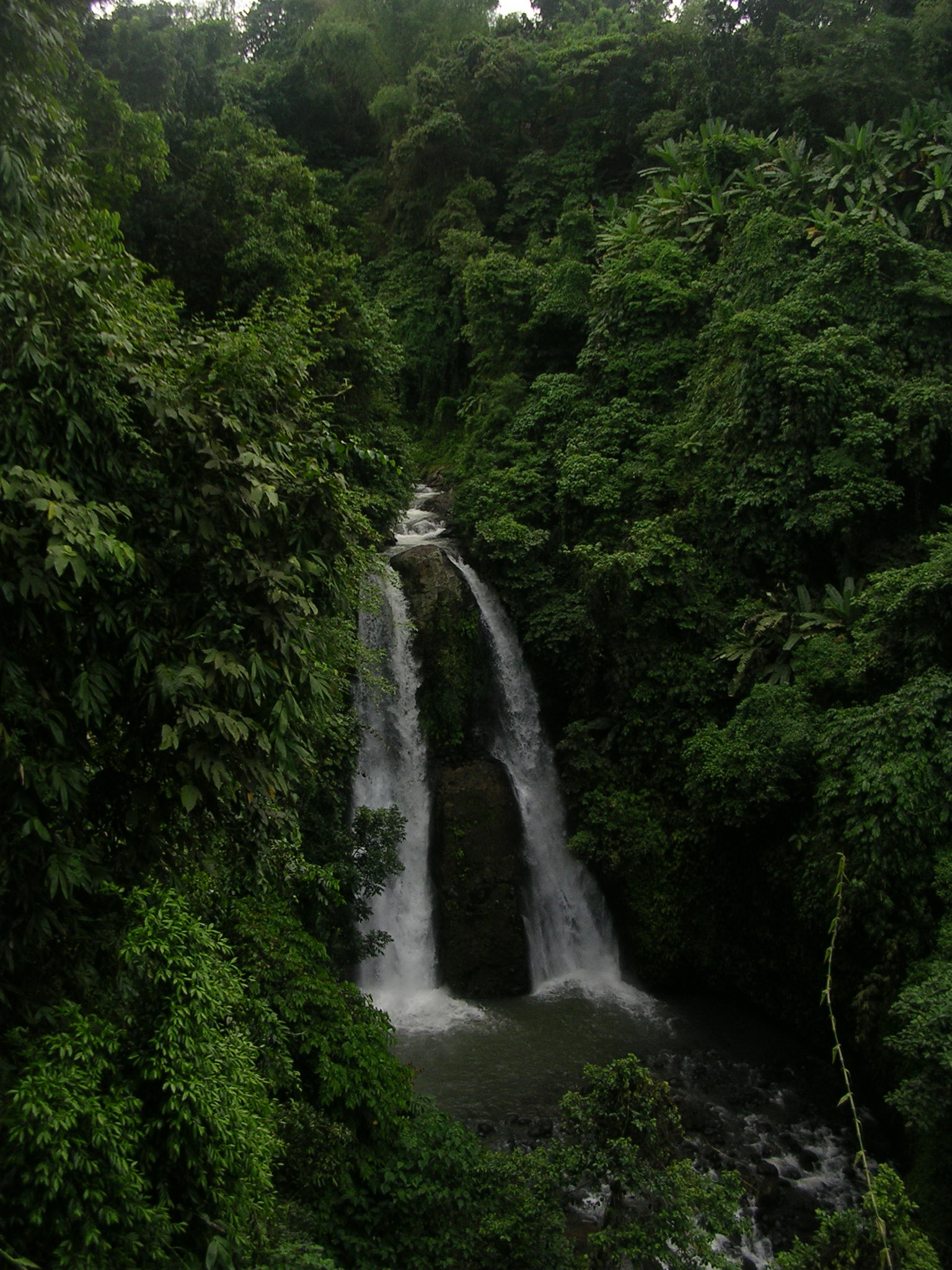
M.A.R.I. & W.M.A.F. MEMBERS TRAVEL ABROAD
The Martial Arts Research Institute adventure in South East Asia began Friday the 7th of Oct. Jakarta, Indonesia /
Negros and Manila, Pillippines.
The group of Artist know as the M. A. R. I. Delegates included eight members from many different M.A. backgrounds.
The cultural and historical side of the trip alone was worth the long flights to the other side of the world but, not as exciting
as the training we received from some of the worlds most respected martial arts masters!
The more than two weeks of training was with ; Guru Drs. Edward Lebe in the art of Baringin Sakti. The art
of Oido De Caburate Arnis with Grandmaster Abraham Gubaton. Dekiti Tirsai Siradas Kali with Grand Tuhon "Jerson Nene" Tortal.
From the out-skirts of Jakarta in a Martial Arts University built and run by the Government to the Mountains
of Ma-ao the people treated us like Kings. All of this was done with Thanks to May & Mike Williams, who ran this trip
and are celebrating the 10th year of this adventure to S.E. Asia.
What made the Diffirence?
When I frist began my study with Shihan Alty I had no idea how much
I already knew and,how much I didn't know. Shihan gave me more than just new techniques , he showed me how to use
and teach what I had in a whole new way.This was one the the biggest reason my art evolved the why it did.
Within our art, one achieves the ability to create rather than
merely imitate. Contained within the techniques are the principles that I try to pass on. Once a student learns the
waza (techniques), he/she is able to develop their own Henka (variations) using combinations or unique applications
of techniques for an infinite number of self defense cases. This allows the student to create waza and applications
suited to his or her own needs, rather than memorizing the techniques I have taught them in the dojo.
Don't forget to breath in your Meditation
Begin by assuming a comfortable seated position. Keep the breathing relaxed
and follow a natural breathing rhythm. Close the eyes and calm the mind. Initially,
while maintaining a natural breathing rhythm, a relaxed body, and a calm mind, begin counting backwards slowly from a Starting
at 100.
Visualize each number clearly in the mind's eye and "speak" the number either silently or aloud.
Exactly what form the number will take when visualized will vary from person to person. It is best to keep it simple. While performing the reverse count, the mind will inevitably wander off on other thoughts and you may lose track of
the number sequence. Each time this happens, return to the last number visualized and resume the count. The
goal is to complete the reverse count without any breaks or loss in focus.
BLACK and WHITE.
Many students over the years have come to me
from other schools as black belt s and one of the frist question always is "Should I were my black belt"?
I suggest the idea of the white page, Nyuanshin, beginners
mind, beginning again, of white turning to black and black to white,making us come full circle.
An appropriate way to deal with the question is to
wear the belt degree from each discipline within the respective class. If there is more than one art in question then simply
change your belt when it is required. A more practical way is to wear a black belt without any stripes at all so it can
be worn in all of the practiced arts. Even when I go to a seminar or tourny I always wear an obi with nothing on it. Its one
of my fovorite feelings to be a white belt again.
| "Somebody may beat me, but |
|
| they are going to have to bleed to do it." |
 THE GIFT
Here's something I've been thinking about as it pertains to the impact and value of the art....so
I put it in writing for the site.
Steve Prefontaine was an Olympian distance runner in the
70's, the only man who ever held every American record between 2,000 and 10,000 meters. Jim Ryun was the American mile
record holder before Pre came along, and its said that his college roomate once observed that he was good enough to be the
next Jim Ryun. To this Pre replied, "Forget Jim Ryun, I'm going to be the first Steve Prefontaine."
This is espicially important in the martial arts because
no two martial artists can ever be the same. Kempo is a very personal art, and every martial artist has different insticnts
and tendencies. Kempo is diverse, involving many different types of techniques and animal movements. There's not
a technique or form that can be passed on exactly as it was learned from its master because it will have a small part of the
teacher embedded in it. Kempo is a style that allows you express yourself in your art, and this makes it useless for
you to try to be Nick Cerio, Kevin Pence, or anyone but yourself. That's not to say that you shouldn't strive for the
same expance of knowledge or work and study ethic as some of the most famous martial artists around, but you will never
be the same martial artist that they are because your art will always be YOURS. That is truly what makes kempo special.
One of my greatest mentors has a philosophy that reads, "Strive to
make the average runner good, the good runner great, and the great runner a champion." You must follow this path in
order to become a great martial artist because of the time and hard work that goes into it. A student should have long
term and short term goals, the long term goal always attaining black belt, and beyond that mastering the art. But you're
not going to go from white to purple, not green to black belt overnight in one big stride, and trying to do so will only lead
to frustration in dissappointment. You must pass through the ranks much in the way the runner passes from average
to champion, and appreciate each goal you attain. In doing so you will learn the most possible from your journey through
the ranks and put yourself in the best position to reach your long term goal.
It's also important to respect and appreciate those you study with because without
them you couldn't possibly be successful. A few years ago I ran into Sensei Kevin's brother Sensei Bryon at Wal-Mart,
and while I hadn't seen him in nearly a year and wasn't studying at the time we talked for nearly an hour about old times
and how things were going now, all this because of the relationship we formed in the dojo. I'll never forget that
he told me that the art would always be there for me when I was through with my other committments, and that is one of the
reasons I study today. This is so true of the arts and also of the people you meet while studying. Like the art,
they will always be there when you need them, and they have much to offer you.
So to be truly successful in the arts you must put forth the best of yourself,
be mindful of your goals, and apply in yourself the best of of what you find in others. And finally, be mindful of another
quote from the late, great Steve Prefonatine---"To Give Anything Less Than Your Best Is To Sacrifice The Gift."
by:
MATT WILLIAMS - SANDAN
Thank-you for thinking;
K. P. Sr. Sensei
|
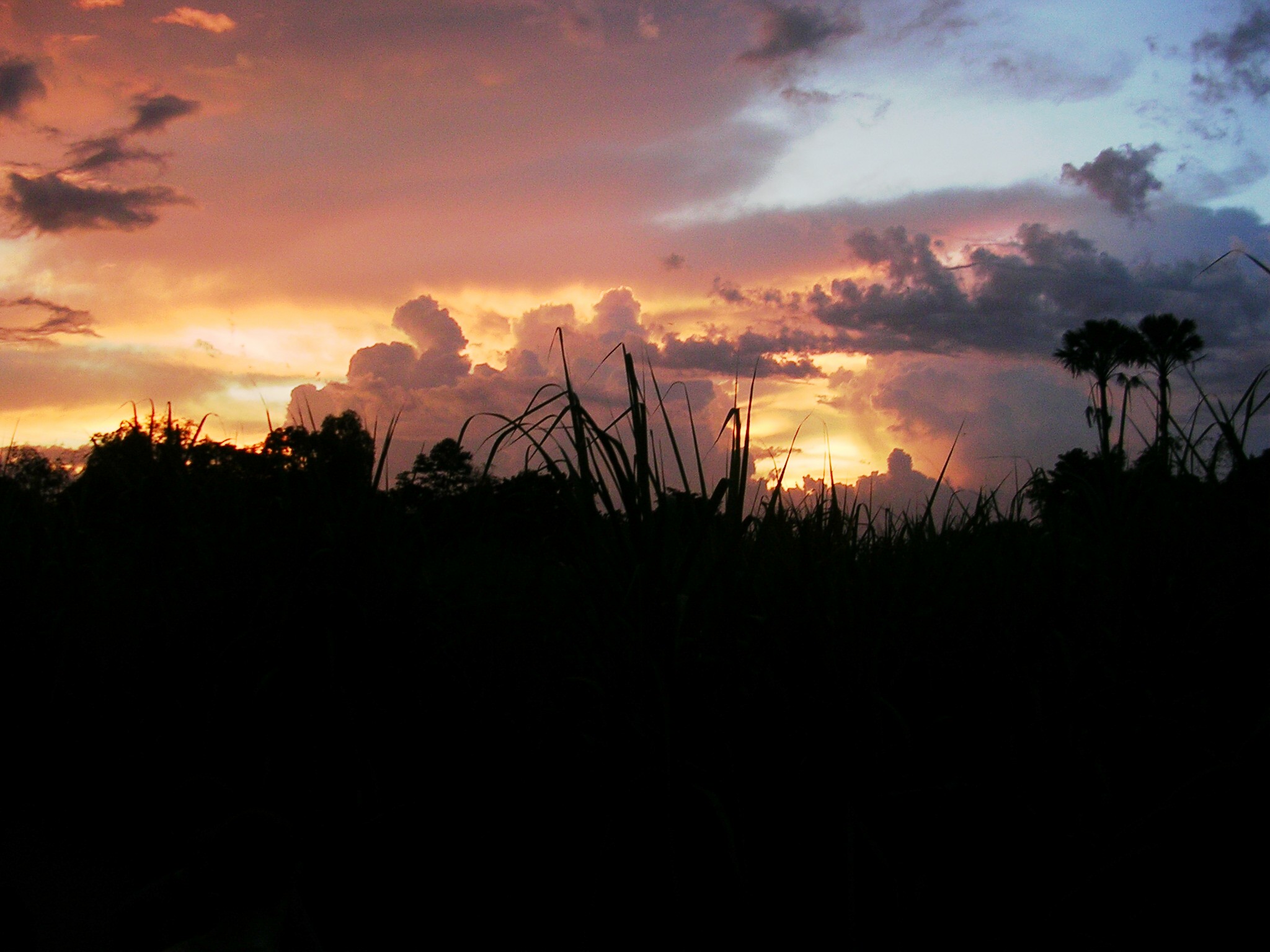
| The Sugar cane sky in Negros, Phillippines |
A sensei "says"
A sensei is human, he understands, forgives others and himself. A sensei
can admit his own error and move on. A sensei is always impartial. A sensei is up to date,
and maintains his teaching skills with continued study. A sensei instills others confidence
in themselves. A sensei has the ability to lead and be able to communicate
effectively under pressure. A sensei is a role model for all, at all times,
even off the mat. A sensei does not act as if he’s better than anyone else. A
sensei must always concentrate on the positives in every student. A sensei is polite, courteous to all
people and is concerned about his students needs. A
sensei uses discretion and honors confidences with students. A sensei is grateful
for the students that train with him.
When your Sensei is gone, the measure of that sensei is... the students. Not all will reach the level but all should aspire to.
K. P. Sr. Sensei
 SHHH! Always
use discretion when explaining to others (friends or family) about our school, where techniques are concerned. this is but
one of the rules of the dojo but maybe the easist to break The
art should only be trusted with persons of the best character and honor. Silence is one things you can do that protects the
society of your training partners and our traditions. Protecting it is part of your duty as a student of the martial way .
Silence is often can be your best line of defense if someone is trying to rope you in to showing your art or pulling you in
to a fight that you have no reason to be in. on your side of the conversation criticism of other styles or practitioners will
not be tolerated in or out of this dojo,therefore there is know reason for a conversation to get out of hand about "my
style is better than yours". Kempo is unique
in that it adapts to your build, personality and spirit.The old masters showed their wisdom when they proclaimed that in a
fight for your life, you should use what you know best and forget about the "style". Every practitioner has different
attributes that can make them effective. If people
widely known of your Martial practices, it becomes a give away of your element of surprise, which is what could be the difference
in surviving an attack, or a trip to the hospital, or calling 911 for him.
|
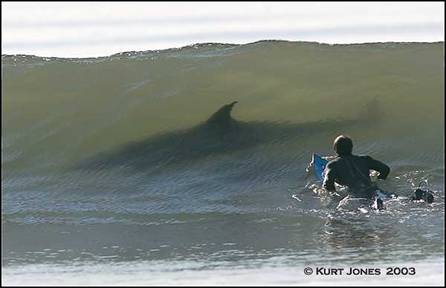
| Remember who's water you are surffing in! |
Distract, Disable, Disarm
aka "3-D"
Distract : Attempt to humanize yourself in the attacker's mind. Speak to them. Begging for
your life, telling them you have a family, none of this will dissuade a criminal from killing you, but talking to your attacker
may distract or lull them into a false sense of security. They should feel in control at all times until the mount their not
Disable: It is better to disable the your opponent than to maim , this should be in our minds.
That being said breaking the attacker's locked joints could happen thru his own struggle. Here is where the root of your training
lies in Self-Defense.
Disarm: Use leverage or induce pain to disarm the attacker. There are many drills in your
art to help you learn to feel disarm and make your attacker feed into them. Even those with combat training may not have real
world disarm skills. Practice until the moves are instinctive.
Understanding
the principles is the most important aspect of training. One must know and understand the reason for everything they do. In
reality, you will rarely perform a "perfect" technique. If you train yourself to have perfect technique while understanding
the reasoning and principles involved, you stand a much better chance of surviving an attack than if you train for poor or
sloppy form. Strength and power must always be controlled. Uncontrolled strength and power can harm you and the innocent.
This includes class...if you try to be fast and powerful without developing the basic mechanics, you could injure yourself
or your partner. Power must be concealed. Strategically, you never want a possible assailant to be aware that you know anything.
Be strong, but appear to be weak.
Training must begin slow. Even those who think they have sufficient training tend to
move too quickly and tend to think they already know . Too often, they get ahead of themselves and do not understand the principles.
As you continue training and get the mechanics down, then speed and power is increased.
Training begins by working on
the body movements and attacks in the simplistic "ideal world". Although "ground fighting" is a necessary combat skill, the
ground is the worst place you could ever be in any attack situation.The mat has been replaced by concrete, rocks, broken glass,
cars, and unseen weapons as well. The rules disappear and your dojo pals are replaced by His buddies. You stand a much better
chance of surviving if you claw their eyes,and sink a knee into their ribs then get back on your feet, rather than wrestling
for 5 minutes, trying to get him in a “tap out”. Stay on your feet and access as many vital targets as possible
with maximum speed. If you are on the ground, get to your feet a.s.a.p. . However, we do not live in an ideal world. As training
progresses, the variables are added in until it becomes fully realistic. As part of any complete combat system, you need to
have ground fighting skills.
Targets
must be applicable and not rely on pain as the focus. For many reasons, many people can withstand a tremendous amount of pain,
that will not affect them until the fight is over. The targets should cause disruption of the physical integrity of the body,
whether it hurts or not. Targets include joints, bones, muscle groups, organs, nerves and air & blood flow. All fundamentals
of movement, attack dynamics and application of force are based on our own physics. All body movements, targets and strikes
are also based on anatomy. Anatomy can explain targets, striking surfaces and points.
Stress psychology will help understand not only the mind of the attacker, but overcome, fear, confusion and do what
is needed.
Real
life Defense must be fast, and powerful. Defenses range from a simple “leave me alone back hand in the face”,
to the time when you may have to take someone's life in order to protect yours or love ones. May that day never come! Attackers range from the "drunk brother in law " to the "broken crowbar -wielding-maniac".
PST is not only about protecting yourself, but others who may be in trouble. How bad would ignoring someone who needs help
be? What if you knew you could help.
Just
because one trains in the arts, doesn't make one invulnerable. Remember, others are trained and capable fighters also. As a martial artist, one has to not only train
themselves physical, but their mentality & spiritual as well. One has to be trained on how to remain calm even is the
most stressful of times. This is a trait often overlooked (by teachers / artist alike ) and can stop many confrontations.
Not to mention many legal cases.
Alcohol
is one of the number one reasons why adults get in to fights. I am not saying don't ever have fun with your friends, Just
be smart and don't get roped it to something you will regret in the morning. Who wants to hear the knock on the door from
the local Police Dept. in the early a.m. hours?
As
a True martial artist, could have avoided whole thing, had one remained calm and composed and using our most powerful muscle,... our Brains.
"BE IN 3-D MODE"
   WOULDN'T IT BE GREAT TO TURN ON THE TV AND HEAR ANY U.S. PRESIDENT,
DEMOCRAT OR REPUBLICAN, GIVE THE FOLLOWING SPEECH?
My Fellow Americans: As you all know, the defeat of Iraq regime
has been completed. Since congress does not want to spend any more money on this war, our mission in Iraq is complete. This
morning I gave the order for a complete removal of all American forces from Iraq. This action will be complete within 30 days.
It is now to begin the reckoning.
Before me, I have two lists. One list contains the names of countries
which have stood by our side during the Iraq conflict. This list is short. The United Kingdom, Spain, Bulgaria, Australia,
and Poland are some of the countries listed there. The other list contains everyone not on the first list. Most of the world's
nations are on that list. My press secretary will be distributing copies of both lists later this evening.
Let me start by saying that effective immediately, foreign aid to
those nations on List 2 ceases immediately and indefinitely. The money saved during the first year alone will pretty much
pay for the costs of the Iraqi war. The American people are no longer going to pour money into third world countries and watch
those government leaders grow fat on corruption.
Need help with a famine? Wrestling with an epidemic? Call France.
In the future, together with Congress, I will work to redirect this money toward solving the vexing social problems we still
have at home.
On that note, a word to terrorist organizations. Screw with us and
we will hunt you down and eliminate you and all your friends from the face of the earth. Thirsting for a gutsy country to
terrorize? Try France, or maybe China.
I am ordering the immediate severing of diplomatic relations with
France, Germany, and Russia. Thanks for all your help, comrades. We are retiring from NATO as well. Bon chance, mes amis.
I have instructed the Mayor of New York City to begin towing the
many UN diplomatic vehicles located in Manhattan with more than two unpaid parking tickets to sites where those vehicles will
be stripped, shredded and crushed. I don't care about whatever treaty pertains to this. You creeps have tens of thousands
of unpaid tickets. Pay those tickets tomorrow or watch your precious Benzes, Beamers, and limos be turned over to some of
the finest chop shops in the world. I love New York.
A special note to our neighbors. Canada is on List 2. Since we are
likely to be seeing a lot more of each other, you folks might want to try not upsetting us for a change. Mexico is also on
List 2. President Fox and his entire corrupt government really need an attitude adjustment. I will have a couple extra tank
and infantry divisions sitting around. Guess where I am going to put em? Yep, border security.
So start doing something with your oil. Oh, by the way, the United
States is abrogating the NAFTA treaty - starting now. We are tired of the one-way highway. Immediately, we'll be drilling
for oil in Alaska - which will take care of this country's oil needs for decades to come. If you're an environmentalist who
opposes this decision, I refer you to List 2 above: pick a country and move there. They care.
It is time for America to focus on its own welfare and its own citizens.
Some will accuse us of isolationism. I answer them by saying, "you're right!"
Nearly a century of trying to help folks live a decent life around
the world has only earned us the undying enmity of just about everyone on the planet. It is time to eliminate hunger in America.
It is time to eliminate homelessness in America.
To the nations on List 1, a final thought. Thanks guys. We owe you
and we won't forget.
To the nations on List 2, a final thought: You might want to learn
to speak Arabic.
God bless America. Thank you and good night.
If you can read this, thank a teacher. If you
are reading it in English, thank a soldier.
True Nature
The true nature
of what everything is, referred to in many traditions and cultures as an enlightenment experience.
The good one
finds in experiencing the truth is that it helps you live life more effectively, in closer contact with others, and in harmony
with the way things actually are. It facilitates your progress toward personal and spiritual goals, enhances any discipline
or work you may be involved in, improves your relationships, and empowers you as an individual.
Silent contemplation
is powerful and profoundly important part of this concept. The mind is the most powerful organ is our bodies and when we use
it, we may completely transform our approach to the arts. We may improved dramatically not only in our martial
arts ability but also our lifes.
What is the
truth..... Well that is a long story, but what I can say is this.... we have a short time on this earth and we
should use everyday as if it were our last, IT JUST MAY BE. Nature
is ... we
come and we go and we are gone.
W.I.A.
THE KIDS WHO SURVIVED the 30s 40s, 50s, 60s, and 70s.......
First, we survived being
born to mothers who smoked and / or drank while they carried us. They took aspirin, ate blue cheese dressing, and didn't get
tested for diabetes. Then after that trauma, our baby cribs were covered with bright colored lead-based paints.
We had no childproof lids on medicine bottles, doors or cabinets and when we rode our bikes, we had no helmets, not to mention,
the risks we took hitchhiking.
As children, we would ride in cars with no seat belts or air bags. Riding
in the back of a pick-up on a warm day was always a special treat. We drank water from the garden hose and NOT
from a bottle. We shared one soft drink with four friends, from one bottle and NO ONE actually died from this. We ate cupcakes,
bread and butter, and drank soda pop with sugar in it, but we weren't overweight because WE WERE ALWAYS OUTSIDE PLAYING!
We would leave home
in the morning and play all day, as long as we were back when the streetlights came on. No one was able to reach us all day.
And we were O.K.
We would spend hours
building our go-carts out of scraps and then Ride down the hill, only to find out we forgot the brakes. After running into
the bushes a few times, we learned to solve the problem.
We did not have Playstations,
Nintendo's, X-boxes, no video games at all, no 99 channels on cable, no video tape movies, no surround sound, no cell phones,
no personal computers, no Internet or Internet chat rooms..........
WE HAD FRIENDS and
we went outside and found them! We fell out of trees, got cut, broke bones and teeth and there were no lawsuits from these
accidents. We made up games with sticks and tennis balls and ate worms and although we were told it would happen, we did not
put out very many eyes, nor did the worms live in us forever.
We rode bikes or walked
to a friend's house and knocked on the door or rang the bell, or just walked in and talked to them! Little league had tryouts
and not everyone made the team. Those who didn't had to learn to deal with disappointment. Imagine that!! The idea of a parent
bailing us out, if we broke the law, was unheard of. They actually sided with the law!
This generation has
produced some of the best risk-takers, problem solvers, and inventors ever! The past 50 years have been an explosion of innovation
and new ideas. We had freedom, failure, success, and responsibility, and we learned HOW TO DEAL WITH IT ALL!
And YOU are one of
us! CONGRATULATIONS! Please pass this on to others who have had the luck to grow up as kids, before the lawyers and the government
regulated our lives for our own good.
Kind of makes you want to run through the house with scissors, doesn't it?!
Sent To Boston Karate . Net by
DEG
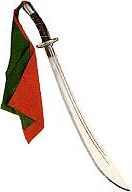
Kata
Whether a one student or an entire class
in unison does the performance, Katas are used to demonstrate the skill, knowledge and discipline of the student. Sometimes
referred to as "forms", Katas are a series of techniques put together to tell a story or re-enact a defense situation. They
were developed for use as a training tool and are a cornerstone of the learning process. Students learn movements
or sequence of multiple movements to perform Kata.There are thirteen for first deg. black belt. Many have hidden self-defense
techniques. There may be as few as ten steps, while others may contain hundreds. Try to wake up to your katas, its a
great way to get the day started .
The name Shotokan
Sensei Funakoshi As a young man he would often walk into the hills and
the pine forests surrounding his Okinawan home town of Shuri where as he says, "he would often listen to the sound of the
rustle of the pines when the wind blew". In his book 'Karate-do, My Way of Life" he says, "to me the murmur was a kind of
celestial music. As a result of his love for these forests he decided to adopt a "pen name" with which to sign all of his
calligraphy and poems. Master Funakoshi therefore got into the habit of signing all his works with the name "Shoto". In Japanese
"Sho" literally translates into "pine" and the word ""to" translates into "waving" hence, "Shoto" means "waving pines".
The word "kan" on the other hand means "hall or building", and so when
his students were asked where they went to study karate they would say, " to "Shoto's kan" or the "hall of the waving pines"
and so over time the name "Shotokan" became associated with Sensei Gichin Funakoshi and his particular style of karate.
Today the name Shotokan is recognized world wide and is the only style
for karate in Japan sponsored by the Ministry of Education.
WHAT IS KARA-TE ?
by N. M.
To the untrained observer, karate skills can seem
like magical superpowers. Using only her body, a 5-foot 5-inch tall, 120-pound karate master can take down a 6-foot, 200-pound
man in a matter of seconds. In strength and sheer bulk, the man has the upper hand by a considerable margin. But somehow,
the karate master prevails with a few elegant punches and kicks. Using the same set of skills, advanced karate students can
break thick bricks and boards with their bare hands and feet. How is all this possible?
In this article, we'll see how students accomplish
such amazing feats. It is impossible to sum up this ancient, transcendental discipline in a short article, but we can
get a handle on some of the underlying principles. Though its highly complex, the root of karate is fairly straight-forward:
By applying physical, mental and spiritual force intelligently and precisely, you can realize the maximum potential of your
strength. Karate is one of the most widely practiced
martial art forms in the world. Martial arts rely on acute physical coordination and mental focus. They were developed in
Asia (primarily India, China and Japan) over the course of several thousands of years. Modern karate developed out of martial arts forms practiced in Okinawa, an island that
is now part of Japan. For hundreds of years, Okinawan martial arts experts honed a variety of combat styles, in part due to
the political situation in the area. From time to time, the ruling authorities would ban peasants from possessing any weapons,
leaving them with only their own bodies and household items to protect themselves.
The word karate is Japanese for "open hand"
(kara means open and te means hand). Te signifies that your main weapon is your body. Instead of an arsenal
of swords or guns, the karateka cultivates a personal arsenal of punches, kicks and deflection techniques. Kara relates
to the psychology of karate. Karatekas are open to the world around them, making them better equipped to handle any attack. When
the ancient martial arts masters were developing their sophisticated fighting techniques, they experimented with fundamental
principles of physics. In any fight between two people, both fighters bring a certain amount of energy to the situation. The
total amount of potential energy depends on the fighters' size, muscle strength and physical health. The object of karate
is to use your body to channel this energy.
At its most basic, karate is a system for varying
the forces of a fight to your own advantage. There are several ways to do this. First of all, you concentrate
all of your strength into a relatively small area. If you open your hands wide and shove somebody, the force of your attack
spreads out across your palm and fingers. This dissipates the force of your attack over a fairly wide area; your opponent
feels a relatively blunt force. But if you hold all of your fingers tightly together and hit the person with only the side
of your hand, or with only your fingertips, that same amount of force is applied to a much smaller area. In that area, the
impact is much more intense.
In karate, there are a number of punching and
kicking stances, but most of them rely on this same basic idea. The point of impact is reduced to some small, usually bony
area of your hand or foot, and the force of your attack is focused on this point. Karatekas strengthen their hands and feet
so they can throw these punches and kicks without seriously hurting themselves. If a karateka continually punches incorrectly,
he may eventually develop arthritis. Karatekas maximize the force of the impact by putting their
whole body into the punch or kick. If you watch karatekas fight, you'll see that they often pivot their torso and shift their
weight from one leg to the other when they throw a punch. In this way, the energy of their moving body goes into each hit
along with the energy of the arm muscles. Karatekas also practice hitting with great speed, as this increases the force of
each blow. One of the most important elements in karate is following through on punches and kicks. When
you hit something, say a piece of board, your natural instinct is to slow down your swing just before impact; you hesitate
because you don't want to hurt your hand. Karatekas deprogram this hesitation instinct; they visualize pushing their fist
to some point past their target (the other side of the board, for example). To maximize the force of each movement, it's essential
that the karateka follows through. Before each attack, karatekas take a deep breath. As they release the punch or kick, they
let this breath out. This helps them focus on each movement. To protect against
attacks, karatekas take on particular fighting stances. Generally, karatekas stand with one leg in front of them and one leg
behind them. This effectively shields the front of the body from attack, and gives the karateka better balance. Karatekas
hold themselves with their center of gravity relatively low to the ground, so it is more difficult for an opponent to knock
them down.
In a karate competition, both karatekas concentrate
on guarding themselves against attack while waiting for an opening in their opponent's defenses. Often, a karateka can land
a successful hit immediately after deflecting the opponent's attack, as this is when the opponent is most vulnerable. A lot
of karate is based on paying attention to what's going on around you, so you can recognize an opportunity when it arises.
by.... " Nobody's Master " sent Via E-mail
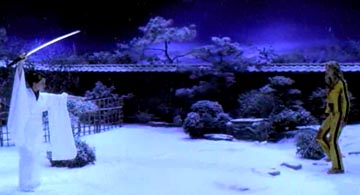
What are The Martial Arts
By Michael Lowe-Shodan
The Martial Arts are known to many as a joke around, a funny
thing, no matter what the style. If someone were to say, that he was to have any knowlege of any art, he could be taunted
by people, who don't take it seriously. They may try to antagonize a person training in the arts, by waving fists, or calling
names. Saying they want to fight you, that they could take the trainee on, to prove that they are better than the person training.
They may say that The Arts are a fools idea of defense, and that braun will overcome all in the end.
The people who believe the arts are a joke are wrong. They
may think what they want, for nobody is stopping them, it is a free country after all. The Martial Arts are both a mental
and physical training for the person studying. The mental training would be to not attack back over verbal assaults, or waving
of fists, or insults to your style, or family or belief, or race.
The arts should train one to be that strong, that mentally
strong to say to ones self, they are words, not fists, they can not harm me in any way, if I choose not to listen.
In the case of most cruel insults, the Arts hopefully
have trained a person to walk away. To walk, rather than fight. The arts train phisyically so, if you were to ever need to
use your art, in the most dire of situations, when there would be no other escape, you could. But, you should never go to
the extremities of dealing with death. "Mame rather than kill" is a line from a famous saying, meaning, if all other ways
are gone to escape, and you have no choice to use your art to protect your family, friends, or self, you would not try to
sink to the level of your attacker. You would not go as low as to threaten another life. That is how I
look at things now, how I deal with them. I have only used my art once, but once is quite enough, let me tell you.
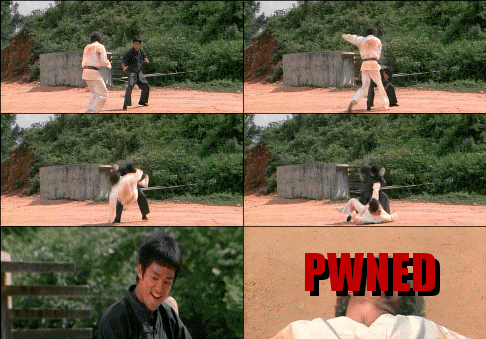
Bruce Lee
Bruce Lee was perhaps the greatest Martial-Artist ever. He
was born in San Francisco, California on Nov. 27th, 1940. A few months after his birth, Bruce and his family move back to
Hong Kong. Bruce starred many films as a child. His first starring role was actually when he was six years old! It was
a role in a film titled "Little Orphan Sam".
At the age of 12, Mr. Lee begins taking Martial instruction
from the legendary Sifu Yap-Man, a master of Wing-Chun gung-fu. During the next few years, when he was not practicing his
art, he could be found in the movie studios with his father. At the age of 18, due to the numerous streetfights he was involved
in, Bruce alone was forced to move back to his place of birth, San Francisco. Bruce arrives with $100 dollars,
given to him by his parents.
While attending the University of Washington, he majors in
Philosophy. It is here he meets his future wife, Linda. He lives with an old friend of his father's, while working at the
Ruby Chow Restaurant, in exchange for room and board.
Unable to finance his education, he begins giving Martial
Arts lessons to various students at the University. Bruce attends a Martial Arts tournament in Oklahoma, where he is "discovered".
He is invited for a screen test for an untitled pilot, which is scrapped shortly before production. Fourtunately, he is chosen
for for the role of "kato" in the television series, "The Green Hornet". The show only lasts for one season, but does lead
to roles in other shows, "Longstreet" and "Here Come the Brides" being two of them. He also gets a small role in the film
"Marlowe". Sometime after the film "Marlowe" is made, Bruce marries Linda. Months later, he opens his first "Jun-Fan Institute",
where he continues to share his knowledge of Martial Arts. Word spreads that Bruce Lee is teaching the "sacred"
Martial Arts to foreigners. Bruce is "warned" by various other instructors of his "violation of the sacred law". According
to the instructors, it was considered forbidden to teach the "sacred" Martial Arts to anyone who wasn't of Asian decent. Bruce
argued this, saying that he wanted to show the beauty of their culture to the world. The instructors laid
down an ultimatium. Bruce was to either teach only Asians, or stop teaching altogether. Bruce refused their instructions,
vowing to teach whoever wanted to learn. Needless to say, the instructors were not pleased, and challenged Bruce to fight
Wong Jack Man, another Martial Arts master in the area. The rules were set, if Bruce lost, he was to stop teaching. If he
won, he would be able to teach who he pleased.
There has been alot of speculation concerning the true outcome
of this battle, even some 25 years later. Publicly, all that is known, is that Bruce won, barely. After this fight, Bruce
decides to re-evaluate his fighting techinique, because the fight "should have been over in seconds". This leads to his creation
of the style we all know as, "Jeet Kune Do". Bruce sustains an injury to his back while training. During
the next six months, while recovering, Linda helps Bruce write what would later be titled "Tao of Jeet Kune Do". Two years
after his full recovery, Bruce's father passes away. He attends the funeral in Hong Kong. While there, as fate would have
it, he runs into director Raymond Chow. It takes a while, but Raymond convinces Bruce to play a role in the film "The Big
Boss",(a k a "Fists of Fury"). Bruce was known around Hong Kong because of his former role as "kato" in "The Green Hornet".
The role Raymond had for Bruce was originally a small one, in which Bruce was actually supposed to die! Bruce amazed Raymond
Chow with his onscreen presence, and Bruce was given the lead role. His performance was extraordinary and he was hailed in
Hong Kong as a hero! The Big Boss was a box-office smash, breaking all records as the first international film to gross more
than $1 million. Raymond asked Bruce to star in another film, "Fist of Fury"( also known as "The Chinese
Connection". This film broke the records set by The Big Boss! Bruce's next film was "Return of the Dragon", (also known as
"Way of The Dragon"). This film also breaks previous records. Bruce begins working on his next film "Game of Death". Before
completion, he is approached with a script for "Enter the Dragon", (formerly known as "Blood and Steel"). He accepts and promptly
stops working on Game of Death. He actually has "cold feet" for the first couple of days! After overcoming this small fear,
he shows up and begins filming. During the course of those long 12+ hour days, he is repeatedly challenged to fights, winning
them all, but at a price.
He collapses and loses conciousness twice during the filming
of this movie. Upon his visit to a doctor, he is told that he has an allergic reaction to hasish and must be careful, because
the next collapse could be fatal. "Enter the Dragon" is later completed. Until the release of the 25th Anniversary Edition
of "Enter the Dragon" this year, few fans knew that Bruce actually watched a completed version of the film.
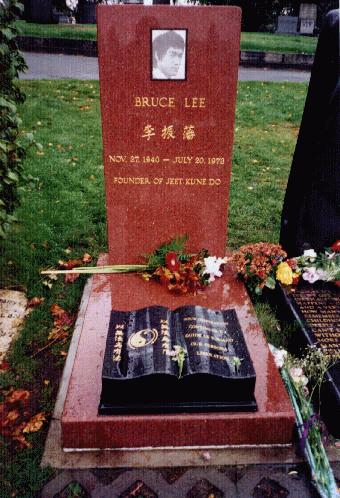
On July 20th, 1973, Bruce Lee is pronounced dead at friend
Betty Ting Pei's apartment. The cause of death was offically ruled as "severe swelling of the brain", but is and forever will
be shrouded in mystery. Ironically, Bruce Lee says in one of his films, "How can a healthy man die?". That would be the very
question all of his fans would ask themselves for years after his unfourtunate death.
Patience Grasshopper
Through our training we experience growth and rank advancement
little bits at a time. What seems impossible at first with time, becomes within our reach. This process teaches us to understand trust
and how it provides the base which allows progress to take place. With trust one has a positive attitude and accepts
that even if we "don't understand" at the moment things will make sense and improve us in time. One must not follow blindly,
but temper one's trust with intelligence.
Because proficiency in the martial arts never comes
all at one time, one learns patience. Things worthwhile often require time to develop. Patience coupled with trust and faith
can guide one to achievement. Without patience one will give up before seeing the results. Patience means the capacity to
wait in the face of what seems like difficult lengths of time. If one has patience one becomes more involved with the process
than with the goal.
This is the key to patience. To have patience one allows
the ability to let go of the end and become the means. Enjoy today tomorow is never for sure.
| Look close! |
|
ABOUT GRANDMASTER TITLES
I would like to address the issue concerning the use of titles
such as Soke, Shodai, Grandmaster and others, as well as some other issues. It seems that there are many traditionalists who
are offended by Americans using these terms. They would rather see the use of the title Soke dropped, and Americans use the
title of Founder. They don't understand why Americans insist on using an Asian term. They are also complaining about 40 year
old Grandmasters. The last time I heard so much whining and crying was from children in a daycare center, and even they didn't
cry as much as some of these people who call themselves martial artists. I will begin with some facts that many may or may
not know.
First, I will address the issue of Americans using Japanese terms. This has been going on since the Japanese
arts were brought to America. After all of these years, Americans still butcher the name Kara-Te. We pronounce it Ka Rotty.
We also see it used in conjunction with the word "American". Schools call it American Karate. Is Karate American? Absolutely
not, but people call it this anyway and it has been accepted as the norm. What about the Koreans? The Korean Yudo Association
has changed its name to the Korean Judo Association. How dare those Koreans use a Japanese term (Judo). Isn't saying Korean
Judo the same as saying American Karate? How about American Kenpo? Many American martial artists use the term dojo or dojang,
yet no one complains about that. Many of the modern schools still teach Asian terminology, respect and discipline. So, this
is okay, but once the word Soke comes into play, it's taboo. It was acceptable for Americans to use the term Sensei. Why is
it okay for a 3rd dan to be called Sensei, or a higher ranking Grandmaster to go by the title of Shidoshi, but not okay for
the founder of a system to have the title of Soke? This does not make sense.
As far as the title of Soke, Shodai or
any other Asian term, why do Americans use it? Well, I am sure there are several reasons. Probably one reason is just because
it sounds better than Founder. It is related more to the martial arts. I, myself, prefer the title Founder, but regardless,
what difference does it make as long as the person has trained hard and earned the title. I cannot speak for everyone who
carries the title of Soke, but I can honestly say that those I have met do not require anyone to call them by this title.
Of course there are those who use the title of Soke to impress people which is not a good practice. Anyone who founds their
own system is a Soke or Shodai, however, that does not mean they should go around calling themselves Soke. Maybe some of the
old Masters such as Ueshiba, Kano, Shimabuku, Oyama and others never used the title of Soke, but nonetheless, all of these
men were.
As for 40 year old Grandmasters, let me shed some light on this subject. Bruce Lee was only in his early
30s when he passed away, yet he was and is still highly respected, yet he never earned a black belt. His art of Jeet Kune
Do is still practiced today by many and Bruce Lee is still admired throughout the world.
At age 31, Hwang Kee combined
Soo Bahk Do / Tae-Kyon, Karate Formd out of books, with the Chinese T'ang method and developed Tang Soo Do Moo Duk Kwan.
At
age 40, Mas Oyama established his Kyokushinkai headquarters. Grandmaster Kang Uk Lee of Tang Soo Do was a 6th Dan at the age
of 29 and by the time he was 40 received his 9th dan. From the information I was able to gather, Grandmaster Ji, Han Jae of
Sin Moo Hapkido studied with Choi, Yong Sool from 1953 until 1956, only three years before opening his own school, An Moo
Kwan. In 1957, Ji held the rank of 3rd Dan in Yu Kwon Sool. Only six years from his beginning with Choi, Ji Han Jae claims
to have founded Hapkido in 1959. And lastly, how dare a 22 year old with only a few years of study in Jiu-Jitsu found his
own art and call it Judo. Jigoro Kano was born in 1860, received instruction in Jiu-Jitsu for the first time in 1877, and
by 1882, he founded Judo. By the time Kano was 40, Judo had come to enjoy great popularity.
Regarding martial artists
who found their own systems, they are not doing anything that the Grandmasters and Masters of the past didn't do. If you look
into the history of what people consider traditional martial arts, every art was founded by someone who trained in different
arts before developing their own. Look at the art of Hankido. This combines Korean Hapkido with Japanese Aikido. Mas Oyama
trained in Chabi (a combination of Kempo and JuJitsu), Shotokan and Goju-Ryu before developing his Kyokushinkai. This is true
tradition. I laugh when so-called traditionalists make comments about newly founded systems. They don't seem to realize that
at one time the art they are studying was also considered a new martial art.
In closing, there are followers and there
are leaders, however, a good leader must have been a follower at one time. Some people are just not leaders, but they should
not slander those who are. If it weren't for leaders, we would not have arts such as Aikido, Judo, Kyokushinkai, Isshinryu,
Tang Soo Do, and many other martial arts. So, why is it that only Asians can found their own style or system after only a
few years of training, yet Americans with 20 years or more in the martial arts who develop their own system are looked down
upon? Are Americans too stupid and unworthy? I don't think so. I do however think there are a lot of people out there who
are close-minded about change and new ideas, and others who are jealous that they are not leaders. It is time for those who
call themselves traditionalists to open their eyes and do some research, and maybe they will see how the martial arts grew
to where they are today and be thankful for those people who took the chance to be leaders.
I have recently received
a letter from a group stating that martial arts organizations with mixed styles are just made up of individuals who could
not make it in the real martial arts. What they are basically saying is that Hwang Kee, Morihei Ueshiba, Yong Sool Choi, Mas
Oyama, Jigoro Kano, Tatsuo Shimabuku, as well as more modern martial artists such as Wally Jay, Bruce Lee, and many others
who founded their own styles and systems could not make it in the real martial arts, or possibly these dinosaurs as they call
themselves are just a bunch of followers who could not make it as leaders and they are jealous of those who do lead. If you
are a follower, then follow, if you are a leader then lead, but one should not look down on others for having a different
outlook on things. The world would never evolve and progress without those who take a chance.
This very informative
article was written by Soke Ed Annibale and with kindly agreement provide to Sensei Kevin Pence Sr. for publishing on the P.D.K. Web-Site.
POSITION : Mom, Dad
PARENT - Job Description
JOB DESCRIPTION :
Long term, team players needed, for challenging permanent work in an, often chaotic
environment. Candidates must possess excellent communication and organizational skills and be willing to work variable hours,
which will include evenings and weekends and frequent 24 hour shifts on call. Some overnight travel required, including trips
to primitive camping sites on rainy weekends and endless sports tournaments in far away cities! Travel expenses not reimbursed.
Extensive courier duties also required.
RESPONSIBILITIES :
The rest of your life. Must be willing to be hated, at least temporarily,
until someone needs $5. Must be willing to bite tongue repeatedly. Also, must possess the physical stamina of a pack mule
and be able to go from zero to 60 mph in three seconds flat in case, this time, the screams from the backyard are not someone
just crying wolf. Must be willing to face stimulating technical challenges, such as small gadget repair, mysteriously sluggish
toilets and stuck zippers. Must screen phone calls, maintain calendars and coordinate production of multiple homework projects.
Must have ability to plan and organize social gatherings for clients of all ages and mental outlooks. Must be willing to be
indispensable one minute, an embarrassment the next. Must handle assembly and product safety testing of a half million cheap,
plastic toys, and battery operated devices. Must always hope for the best but be prepared for the worst. Must assume final,
complete accountability for the quality of the end product. Responsibilities also include floor maintenance and janitorial
work throughout the facility.
POSSIBILITY FOR ADVANCEMENT
& PROMOTION :
None.
Your job is to remain in the same position for years, without complaining, constantly retraining and updating your skills,
so that those in your charge can ultimately surpass you.
PREVIOUS EXPERIENCE :
None required unfortunately. On-the-job training offered on a continually exhausting basis.
WAGES AND COMPENSATION :
Get this! You pay them! Offering frequent raises and bonuses. A balloon payment is due when they turn 18 because
of the assumption that college will help them become financially independent. When you die, you give them whatever is left.
The oddest thing about this reverse-salary scheme is that you actually enjoy it and wish you could only do more.
BENEFITS :
While
no health or dental insurance, no pension, no tuition reimbursement, no paid holidays and no stock options are offered; this
job supplies limitless opportunities for personal growth and free hugs for life if you play
your cards right.
sent in
via e-mail from Sensei Wink
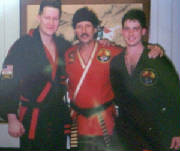
Not Forgotten
To most of the people I know I am just Kev but to a few select I am Sensei. How does one get to this place?
Well, for me I knew I wanted it from the first day I saw Master Carozzi teach a young girl how to block a kick and not get
killed doing it ! The power to empower others is the best feeling ever. It is like nothing else in the world to know that
you may help someone to defend themselves without even having to be with them, was a thought that was appealing to me from
the get go.
Master Carozzi was who I first went to and ask if I may help in teaching some of the adult white belt students.
When Master Cal said it would be o.k. if I helped with the kids class I got a lump in my throat and said o.k., but was scared
to death. I had never had younger bothers or sisters or cousins to speak of nor had I had anytime spent with young people.
After the first week of teaching the kids, I felt more at ease and was having the time of my life. This dream
was made true by the wisdom of the man who got me started in teaching Calvin C. Carozzi. He knew if I could over come my fear
of teaching kids that it would be easy for me with the adults. Thanks Master Cal for everything.
One should never criticize his own work except in a fresh and hopeful mood. The self-criticism
of a tired mind is suicide.
Charles Horton Cooley 1864
"Don't let it be Your last thoughts".
Sensei K.P.
FOR LOVE or MONEY
Ask yourself about your Master or teachers, what have they done for their Communities, how
much have they help the needy. Have they used the Arts to accomplish selfish ends or have they used their knowledge and experience
to enhance in a peaceful way the lives and those students who they have taught.
While it true that all dojos must
pay the rent the phone, lights etc. . We should Never compromise the Integrity of the Arts for a fist full of Dollars. The
days of $600 or $500 test fee and $2999.00 "Black Belt programs" are still alive in many towns. The "Mc
Dojos" of the 70s, 80s, 90s have given all school owners a bad name. While I am very proud of my Art and my Student,
sometimes it is hard to tell pepole what I do (in my martial life) for fear of them having been riped
of by some so called grandmaster so and so and asuming I run the same type of school. No matter what they see good,
they will always have that bad master in the back of thier heads.
This raping of the arts in the U.S.A. should
be the way of the past and should never be allowed to happen again. If the Master needs $$$ that badly, he or she should get
a job at Wal-Mart!
In the end it should be about the Love of the Arts, the passing on of and performing of and Never about the bi-product
of Money.
Sensei KP
Hot or Not
While it might have some effect to toss a pot of cold water on
any given attacker, it would be nothing like the effect of that same pot of water at 180 deg. One is a shake the other is
a trip to the E.R. Like a pot of boiling hot water, so is the Martial way that is being trained on a daily bases.To all of
those who think it is enough to know some self-defense tricks, let me tell you... this is a dangerous path. Rank aside if
you as a Martial Artist do not work on the basics of the the blocks, locks, traps, and strikes you may as well dump the cold
water on yourself, maybe it will wake you up to the truth, "that constant training is the only way to keep your water hot".
This does not mean that you should just show up to class three
times a week, it does mean you should work as hard as you can during all training sessions in dojo and out! If you are training
in the dojo on a regular schedule! Now make an effort to keep it real, "hard work is the only way to proficancy".
If you are on a long break from dojo life, make an effort to
get yourself back on the range and the fire back in your life!
Sensei K.P.
 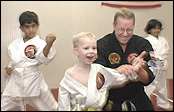
For Pence, home is where the 'hah!' is
By
David W. Smith / Staff Writer
Thursday, August
28, 2003
Karate teacher in hall of fame
About three years ago, Kevin Pence stood at what appeared to be a difficult crossroad
in his life. On the same day, the Peabody karate instructor was offered a promotion at the
Beverly restaurant where he works, and the opportunity to buy his own karate school in Burlington. He could be the general
manager of the Beverly Depot, but this would take up a lot more of his time and energy. For Kevin, 33,
the path was clear. A teacher for 10 years already, Kevin and his wife Jacqui knew immediately they would
purchase United Shaolin Kempo on Cambridge Street. It was a move that might spell exhaustion for some - Kevin continues to
work full-time at the restaurant and pursue his own karate studies in Medford. But his school, or dojo, has quickly become
a second home for Kevin, and a source of energy and inspiration. "Every waking moment I'm not at the restaurant,
I'm here," said Kevin. "My family is all here." As he prepared to teach a class Wednesday, Kevin was surrounded
by family. Two of the family's three children, David and Katherine, were dressed to participate in class. Jacqui, who helps
run the place while earning her own black belt in preparation for teaching, tended the baby. "We [should]
bill it as a fertility clinic," he laughed. Jacqui said her family, many of whom study karate, all spend
a lot of time helping out around the school. "By owning our own school, we get to be with our family.
We try to get the whole family involved," she said.
It's a system that appears to be working. When they purchased the school in May 2000, the place
had deteriorated and the number of students diminished. The owner and instructor, Brenda Richards of Peabody, wanted to move
to Europe, but struck up a friendship with the couple. She was apparently impressed by their dedication. "She
said ... you deserve to have this," said Jacqui. Kevin knew he was in line to succeed his own instructor
and take over the school where he was teaching in Peabody, but this was an opportunity worth taking. Now, student enrollment
is up 300 percent according to the couple. Long-time students are happy, and last month Kevin was inducted into the Universal
Martial Arts Hall of Fame as instructor of the year in Shaolin Kenpo karate. It's a series of events Kevin
said he can scarcely believe. "I had no idea," he said referring to the distinction in one of the predominant
karate organizations in the world. "When they first contacted me, I was suspicious." The couple traveled
to Texas last month, where Kevin received his award.
Wednesday afternoon, Kevin led a group of children wearing white, yellow and green belts into
the studio. Soon his deep, throaty "hah!" was echoed by a high-pitched chorus of shouts as the warm-up began. "Don't wiggle the foot. Keep it straight," he said, moving from student to student, correcting their posture during
a series of kicks. Teaching is a very rewarding thing, he said. It requires creativity and his own dedication
to constant learning. He believes it is possible to teach some karate to anyone, regardless of natural ability. "The most-needed quality is patience," he said. "Every kid is a different learner." According to
Jacqui, Kevin is such an enthusiastic and passionate teacher she never doubted buying the school was the right thing to do.
He will teach any time, any place and offers classes to everyone from developmentally disabled adults to children so young
they had to invent a song to teach them how to tie their belts. "We have to stop him from teaching his
classes. We have to tell him 'time's up,'" she said. "I hope I can be half the teacher he is." Kevin,
who grew up in the Outer Banks of North Carolina, said he practices a combination of Shaolin Kempo, which is a style of karate
originating from Okinawa, Japan, and Shaolin kung fu. He first began training at about the age of 7 with his father, a Golden
Gloves fighter. When he moved to Massachusetts in 1988, his formal training began. "There's a lot of different
pieces I've picked up from both arts over the years," he said. Kevin will be testing for his fourth-degree
black belt in September - an arduous task that involves documenting in writing virtually everything he's learned and discovered
about martial arts over the years. "I love learning new stuff so I have more to pass on," he said. "I'm
probably going to be a student the rest of my life."
United Shaolin Kempo Karate of Burlington will host an open house from 9 a.m. to 2 p.m. on Saturday,
Sept. 6.
- Nearly all first use of tobacco occurs before high school graduation. If you can keep them from using tobacco
when they are adolescents, most people will never start using tobacco.
- Cigarette smoking causes significant health problems among children and adolescents including coughing, production
of phlegm, more respiratory illnesses, decreased physical fitness, risk for cardiovascular disease, and decreased lung growth
and function.
- The younger you begin to smoke, the more likely you are to be an adult smoker.
- Young people who begin to smoke at an earlier age are more likely to develop long-term nicotine addiction
than later starters.
- Most young people who smoke regularly are already addicted to nicotine and experience the same addiction
as adult smokers.
- Most adolescent smokers report that they would like to quit smoking and have made many, usually unsuccessful
attempts to quit. Those who try to quit smoking report withdrawal symptoms similar to those reported by adults.
- Adolescent tobacco users are more likely to use alcohol and illegal drugs than are nonusers. Cigarette smokers
are also more likely to get into fights, carry weapons, attempt suicide.
- Young people are the chief source of new consumers for the tobacco industry, which each year, must replace
the many consumers who quit smoking and those who die from smoking-related diseases.
Tobacco
use among middle school students
- In 1999, about 15% of middle school students reported using some form of tobacco (cigarettes, smokeless,
cigars, pipes, bidis, or kreteks) at least once in the past month.
- Cigarettes (9.2%) were the most prevalent type of tobacco used, followed by cigars (6.1%).
- Cigarette smoking was similar among boys and girls, but boys were more likely than girls to use smokeless
tobacco, smoke cigars, and smoke tobacco in a pipe.
Tobacco
use among high school students
- Just over a quarter (28.5%) of high school students smoke cigarettes currently according to the Youth Risk
Behavior Surveillance System (YRBSS). Teen smoking apparently peaked in 1997 at 37%. About a third (33.8%) of high school
students have used some form of tobacco (cigarettes, chewing tobacco or snuff, or cigars) at least once in the past month.
- Fifteen per cent of middle school students currently use some form of tobacco. Every day, more than 2,200
young people under the age of 18 become daily smokers.
- In 1999, about 2 in 3 (70.4%) high school students had tried cigarette smoking, even one or two puffs. By
2001, that number had fallen to 63.9%.
- In 1999, about 17% of high school students described themselves as frequent smokers, but that fell to 14%
in 2001. Frequent smoking was defined as smoking on 20 of the 30 days before the survey.
- Regardless of race, male high school students were more likely to use smokeless tobacco than female students.
White male students had the highest percentage of smokeless tobacco use (19%).
- Male students (25%) were more likely to smoke cigars, cigarillos, or little cigars than female students (10%).
Programs
to Reduce Teen Tobacco Use
ACS Comprehensive Plan for Community Control of Tobacco
ACS School Health Initiatives
| CLICLK HERE FOR |

|
| MUCH MORE INFO! |

Give Up This One Thing. Shed Pounds
It's actually pretty simple: Give up the soda pop. Lose weight.The healthiest thing you could do for yourself
is to trade in that can of soda for a bottle of water. People who drink regular soda consume about 10 teaspoons of sugar and
150 calories per 12-ounce can. Here's the kicker: When we consume empty and excessive calories in drinks, we don't cut back
on food to make up for it, Purdue News reports of research from Purdue University that was published in the International
Journal of Obesity. So we get fat--just from drinking soda.
Study leaders D.P. DiMeglio and Richard D. Mattes put 15 healthy male and female volunteers on either a "soda
pop diet" or a "jelly bean diet." Each person consumed an extra 450 calories of either soda or jelly beans every day for a
month. And then they switched "diets." Those who had been drinking the soda switched to the jelly beans and vice-versa. The
results: When the participants ate the jelly beans, every single one of them decreased the number of calories they consumed
in other foods to compensate for the candy's calories. Their total caloric intake for the day ended up being about the same
as it was before the "jelly bean diet." So they didn't gain weight. However, when they drank the extra calories as soda, none
of them changed what they ate. So they really did consume 450 extra calories every day--and not surprisingly each gained weight.
In the past 30 years, soda consumption in the United States has almost tripled, according to the National
Soft Drink Association. We're also drinking more juice, sports drinks, and "designer" coffee and tea--all of which are packed
with calories and none of which elicit that same "full" feeling we get when we eat the same number of calories. "Beverages
are not solely to blame, but accumulating evidence indicates that caloric drinks are contributing to excess calorie consumption
in this country, and thus a national trend toward being overweight," Mattes told Purdue News.Here's the startling fact you
may never have considered: If you drink soda and you don't eat less food to make up for those extra soda calories, you will
gain weight. Calories count.
Plain old water is still the best way to quench your thirst fast. It's easy to digest and very accessible.
Besides, it can help quell those hunger pangs so you'll eat less.
 What
is a Black Belt?
The martial arts training process is a powerful experience.
It is an opportunity to alter your capacities to accomplish goals, and the difference that you make in yourself can lead to
great things for others you may teach. To know that every time I teach a student it may change his or her life is a very powerful
feeling, but to see that student help another is the most rewarding because you know that the circle is still moving and that
you were in some small way a part of helping the arts to survive.
To most people entering the study of Kempo, the Black
Belt seems an impossible goal, but regular, consistent training and the right mindset, one could get there around three to
five years or so. Over this trip you will learn all of the technical skills required to test for your Black Belt,
a piece of black cloth ! Being a Black Belt does not make you invincible, you will still make mistakes. Being a Black
Belt will not stop others from trying to bully you, it will not stop your bleeding when you are cut. What it will do is make
you more aware of your vulnerability and better able to cope with bad situations! A Black Belt degree is a journey of yourself,
you should become a more capable individual, a being with Confidence, Respect, Discipline, Compassion, and Courtesy but most
importantly.. Humility. We don’t try to prove that we have superior skills as it will only attract attention by those
looking to prove their own ego, though we should not be ashamed of all the hard work you have put into attaining the goal
of a Black Belt degree.
The arts as a whole should try to build a person's psychological
persona as well as turning the Ego self into the Ego less self. The true Kempo is not a means to fell an opponent by force
of hand or weapon, nor was it originally intended as a means of combat. Kempo calls for a bringing of inner peace to ones
self. A Master of Kempo is not only a Master of self-defense, but a Master of Him or Her self!
While their are many who call themselves Masters of the
arts, I have found but a few with the emotionally maturity that practitioners and much less "Masters" should have. The real
strength of the Arts is not in dominating someone. The real strength of martial arts practice is how it affects the individual's
spiritual and emotional development and ultimately the quality of all human life. Although this point may never be fully comprehended
by some, it is well understood by those who take the martial arts seriously. Stay focused and within your own art of being
a good person first and a great martial artist a close second.
Our training in the Arts can function as a road to our own
self-knowledge, providing you choose to use it so. When you train you have a choice. You can train your body, or you can train
your mind and your body. In the first case you'll obtain benefit by becoming healthier and stronger. By approaching our training
with focus on mind and body, by constantly questioning, as well as challenging, the different aspects of ourselves. That's
how we will acquire self-knowledge, and by so doing, our training can help us along the road to success of the most meaningful
kind.
We must not misuse our skills, We must treat what we have
acquired with responsibility and give our Arts the respect they deserve and Learn how to pass it on to others, as our Sensei
passed it on to us. That is what being a Black Belt truly is !
Yours in the arts
Sensei Kevin W. Pence
"THERE ARE MANY TITLES IN THE MARTIAL ARTS SIFU, SHIHAN, INSTRUCTOR, SENSEI, MASTER,
HANSHI, BUT THE MOST IMPORTANT TITLE YOU CAN HAVE IS THAT OF STUDENT".
| Why did the chicken cross the road? |
|
| To kick this little kid's BUTT |
MASTER?
MANY OF THE MASTERS I HAVE RUN INTO OVER THE
YEARS WOULD HAVE YOU BELIEVE THAT IT IS BEST TO STICK W/ ONE STYLE AND ONE SCHOOL, AND I CAN SEE WHY THEY SAY THIS, FOR FEAR
OF MORE LOST STUDENTS TO OTHER DOJOS. I
DISAGREE, IT IS HEALTHY TO SEE OTHER ARTIST AND THEIR DOJOS. I HAVE ALWAYS FELT THAT MY STUDENTS WILL THEN REALIZE HOW TRULY
GREAT THE ART OF KEMPO IS, AND IN TURN I WILL FIND MORE OF THE LONG TERM STUDENTS THAT EVERY TEACHER WANTS IN HIS OR
HER SCHOOL.
IF YOU EVER FIND ONE OF THESE MASTERS WHO SAYS
"YOU MUST ONLY STUDY WITH ME!" GET AWAY AS FAST AS YOU CAN, THEY ARE NO MASTER AT ALL THEY ARE A WASTE OF YOUR TIME AND COVENT
WHAT LITTLE KNOWLEDGE THEY DO HOLD ON TO. "A BRILLIANT MAN DOESN'T GET THAT WAY BY READING ONLY ONE BOOK IN THE LIBRARY."
THERE SHOULD BE NO SHAME IN SEEKING
KNOWLEDGE.
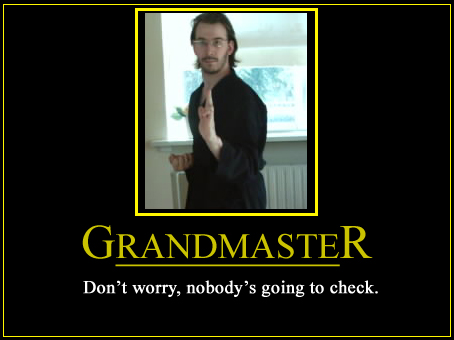
SENSEI
A few years ago I went to see a Master
teach a seminar. It became apparent that he was not teaching as much as performing. I began to feel sorry
for the people that paid to learn but were getting a show. It was a good performance and should have impressed all, but
it was a poor way of teaching. It is my hope that after every class at this dojo or any
seminar I teach at, that everyone has some new knowledge to take home with them. Anyone can
open a dojo to showcase their own skill, but to be a teacher, a Sensei is very diffirent and much harded than
being a performer.
kp sensei
IN THE FIRST PLACE!
Kempo Karate is one of the oldest forms of martial arts. All martial arts
began in India. A man named Bodhidharma was a Buddhist monk who traveled into China, arrived in Shaolin-si (small forest temple),
China from India and taught Zen Buddhism. He also introduced a systematized set of exercises designed to strengthen the mind
and body. These exercises marked the beginning of the Shaolin style of temple boxing. Bodhidharma teachings later became
the basis for the majority of Chinese martial arts. The monks were in a poor condition physically and mentally, due
to the amount of time the monks spent sitting in meditation without any physical exercise. In return for the monks
teachings and lodging, Bodhidharma taught them his fighting art, Chuan Fa, which is Chinese for Kempo, as well as the Buddhism
principles. Thus Kempo's origins are in China from the monks of the Shaolin. The English definition of Kempo is fist
law, or hard fist.
In 1921, at the age of five, James Mitose went to Kyushu from his home in Hawaii, to study with
his uncle, a Kempo master named Choki Motobu. For fifteen years, he studied this art, which was a direct descendent of the
original Chinese Chuan Fa. Mitose returned to Hawaii in 1936 to train others.
One of his black belts was William K.S. Chow. In 1949, Chow had
attracted a following of students to his own teaching style and opened a Dojo of his own at a YMCA. To make his art more distinctive
from Mitose's Kempo, he named his style Kenpo. Since then there have been numerous modifications of the original teachings.
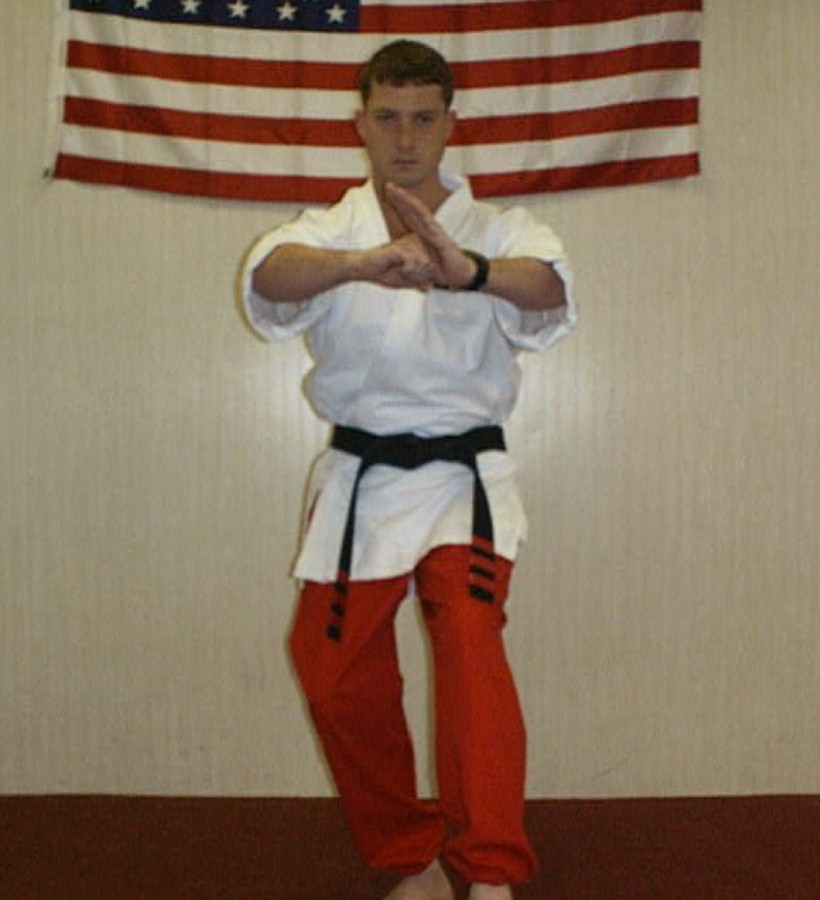
|
| Sensei Bryon Pence |
A BRIEF HISTORY
OF SHAOLIN KEMPO KARATE:
By
Sensei Bryon Pence [Sensei's brother]
The
roots of Shaolin Kempo Karate is clouded as it is mysterious. The origins of Shaolin Kempo Karate can be traced back to the
famed SHAOLIN TEMPLE in Henan province, China.
As history has it, there were 7 Temples of Shaolin, which were all burned
except for one, all representing the Buddhist philosophy , during the many religious upheavals; Buddhism was declared wrong,
and changed to religious beliefs of Confucius, but the monks of Shaolin continued their practice. As time went by the monks
religious practice spread to others, it soon reached India where Buddhism was their main religious belief . India sent their
top philosopher,Da Mao,a warrior prince to investigate and help further the word of Buddha. Upon reaching China and speaking
with the Emperor, Da Mao traveled to the Shaolin Temple. After reaching the temple he was very dishearten, the Monks of Shaolin
were very weak and often would fall asleep during the many hours of meditation required of them, and the other Monks required
to attend and assist with the daily tasks of living, i.e. preparing meals, were to weak to do their jobs effectively.Da Mao
had to find a way to help these dedicated Monks. He secluded himself in a nearby cave to meditate and ponder the answer of
what to do, after several years of intense meditation he had the answer. He returned to the courtyard of Shaolin and called
out all of the Monks, young and old. He taught and worked with them on a series of breathing and movements called 18 hands
of Lohan. These exercises strengthened their bodies and helped purified their minds. After many years and many, many cultural
revolutions the Shaolin monastery came under attack by bandits, out to destroy the Temple. After time the Monks of Shaolin
refined these movements into a way to defend themselves and the Temple, thus the art of Shaolin Ch'uan Fa,or way of the fist
was born. And the Shaolin fighting monks became world renowned for they're their martial art skills. Since that time many
changes have happened and many people have practiced the art of Shaolin Ch'uan Fa, and many great people are responsible for
the furthering of Shaolin Kempo Karate.
Some of these great Masters are Master James Mitose and Professor William Chow,
also known as THUNDERBOLT for his power great speed and precision. These two great men are responsible for the combination
of Shaolin Kempo Karate. As legend has it, while working with each other in the martial arts, they combined their family arts
of Kung-Fu and Kempo, and Karate.
As these Masters went their own ways they changed the spellings of their art as not
to offend one another, one was Kara-Ho Kenpo and the other was Shaolin Kempo,but these spelling changes are still pronounced
the same KEM-PO. These Masters taught many great students, some of which are Professor Edmund Parker, who was noted for bringing
Kempo Karate into the eyes of the American public. Who in turn taught such greats as Professor Nick Cerio,who refined these
techniques and taught many martial artist of today. He provided a very scientific, and traditional approach to Kempo.
Master Carozzi has his head
Dojo in Peabody, MA. He has taught Shaolin Kempo Karate to hundreds of martial artists at this location for more then 30 years
and a select few of his students have been hand picked directly by Master Carozzi to operate Martial Art schools teaching
his art of Shaolin Kempo Karate called San Chai Na Kempo. There are locations in Peabody, Waltham,Yarmouth Me. So as you can
see our roots run strong and deep as well as diverse and complicated. There have been many branches off of the ancient tree
of Kempo but like all living things, they must expand and grow. Most of the history of Shaolin Kempo Karate has always been
shrouded in mystery as it has many different origins.. And their has always been a dispute of who passed it onto who and who
taught who, as most of these events were not recorded but as it is stated in the title of this document this is a "brief"
history of Shaolin Kempo Karate.
This short story of Kempo history was from my Brother; Sensei Bryon Pence........
as told to him from his Master,
Cal Carozzi Sr.
|
|
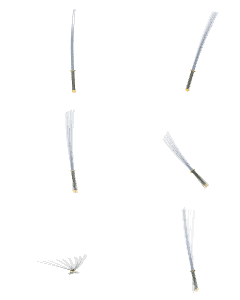
TESTING 1. 2. 3.
ONE OF THE QUESTIONS I GET MORE
THAN I SHOULD IN THE DOJO IS, " SENSEI, WHEN AM I GOING TO TEST NEXT"
RANK IS SOMETHING FOR US AS KEMPO-KA,
TO KNOW EACH OTHER BY IN THE DOJO ONLY. IT IS NEVER TO BE ASKED FOR, AND NEVER TO BE TALKED ABOUT OUT SIDE OF THE DOJO, AS
IT IS HOLY ONLY INSIDE THESE WALLS. RANK SHOULD ALWAYS BE RESPECTED FOR THE PERSON WEARING A HIGH RANK HAS WORKED FOR MANY
YEARS TO OBTAIN SUCH RANK. ASKING SHOWS DISRESPECT FOR YOUR TEACHERS JUDGMENT AND A LACK OF PATIENCE ON YOUR PART.
IN MANY CASES THE GREATEST
MASTERS OF THE ARTS DON'T KNOW THAT THEY ARE, THEY JUST ARE! THEY
DONT GET CAUGHT UP IN THE BELT GAME AND THEY DON'T NEED ANY ONE TO TELL THEM THAT THEY ARE GREAT. BE THAT MASTER! A MASTER
OF YOURSELF AND THE REST WILL FALL INTO PLACE !
"IF WE ONLY KNEW WHAT WE KNOW!"
THIS IS SOMETHING I HAVE HEARD FOR MANY YEARS,
AND JUST RECENTLY GOTTEN BACK TO. ALL OF THE FANCY NEW FORMS IN THE WORLD WILL NOT MAKE YOU OR ME A BETTER MARTIAL ARTIST,
BUT TAKING WHAT YOU AND I ALREADY HAVE AND BREAKING IT DOWN AND EXPANDING OFF OF THE COMBOS THAT YOU ALREADY HAVE IS
WHAT WORKS . WORK THEM, PLAY WITH THEM, SEE WHAT MAKES THEM TICK FOR YOU DO THE SAME WITH YOUR KATA AND PINANS. MY STYLE OF
KEMPO IS VERY FLEXIBLE TO THE ARTIST. MOLD YOUR ART TO FIT YOU . CONSTANTLY ASK YOURSELF WHY THIS TECHNIQUE WORKS GOOD FOR
YOU OR WHY IT DOESNT. "We do not stop playing
because we grow old; we grow old because we stop playing." SOME ONE ONCE TOLD ME TO GAIN SKILL WITH ANY WEAPON YOU MUST PLAY
WITH IT LIKE A CHILD PLAYS WITH HIS FOVORITE TOY ...EVERYDAY THIS IS ALSO TRUE OF YOU FRIST WEAPON, YOUR HANDS AND FEET .
Okinawan's Continuous Attack
Renzoku ken (continuous fist) is an ancient combat principle developed in Okinawa. Although it is
still found today in some shorin-ryu and goju-ryu karate schools, few practice as it was originally developed by the
Okinawaens.
These warriors practiced an art called bushi-te, it was designed to let them to defend themselves
in most any situation. They were less of a army, and more like a peacekeeping force to deal with criminals and provide security.
The art they practiced needed to meet various criteria.
First, the art had to have excellent grappling applications for
use in subduing and restraining prisoners, it also needed to include the devastating token one-strike kill technique for life-or-death
situations. It also addressed vital-point strikes, so they would know where to deliver blows which could injure or kill
an attacker. And finally, for those situations when grappling was ineffective and the one-strike kill was foiled, the art
provided a follow-up attack known as renzoku ken.
Renzoku ken is a process in which basic techniques of ping-te are
expanded so that if the first strike is unable to stop an attack, the defender follows up immediately with a natural flow
of techniques. When kempo karate was first brought to the U.S. the art's most noticeable attribute was renzoku ken, so much
so that as American styles developed, many were shaped around this principle.
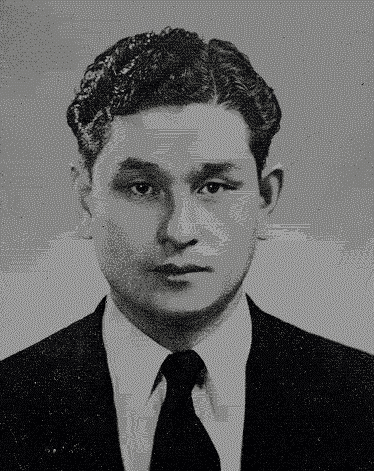
MITOSE'S LIFE & DEATH
James Mitose spent the final years of his life behind bars, and died in Folsom Prison in 1981 for a crime
that was committed by a student. Was he taking the responsibility for one of his students, Why was the alleged killer
allowed to go free after serving just three years in prison? There are many questions.
James Mitose was born in Hawaii
in 1916, sent to Japan at a young age to learn his family's traditions and their martial art, kosho-ryu. In the 1930s, he
returned to Hawaii and taught the art to American soldiers. The day after the attack on Pearl Harbor, Mitose made one of the
most difficult decisions, He turned his back on his heritage to defend his homeland, enlisting in the territorial guard. Mitose
opened the Official Self-Defense Club in Honolulu, where he taught his art to all. In 1956, Mitose moved to the mainland Ca., where he continued teaching Kempo.
Things went well for nearly 20 years, but on March 20, 1974, a Los Angeles strawberry farmer was murdered. Mitose
was convicted of first-degree murder and was sentenced to life in prison even though he wasnt the man who did the killing.
The real killer plea-bargained out to a prison term of just over three years. Meanwhile Mitose, spent the next seven years
in prison and died 1981.
James Mitose was depicted as a man who was able to cast spells
on his disciples and get them to do his bidding. Prosecutors alleged that Mitose told his student to attack the farmer because
he owed money. Mitose lent a Los Angeles strawberry farmer $10,000. In traditional Japanese culture, if you prospered, you
paid a loan back tenfold. If you didn't prosper you owed nothing. The farmer prospered, and paid him back $60,000. The
farmer's daughter was at that time dating an assistant Los Angeles district attorney. When she told her boyfriend about
the $60,000 repayment, he said it was extortion.
The farmer subsequently told Mitose that he would not repay him any more
money, causing a heated argument between the two friends. He then felt very bad about the argument . At the time, he had a
student who he had been teaching the spiritual concepts of kempo, and the student volunteered to act as mediator. Instead
the student got into a fight with the farmer and killed him. The student was arrested, and in return for a second-degree murder
charge, the student claimed James Mitose ordered him to kill the farmer. During the trial, Mitose told the court that he alone
was responsible for his student's actions. This was Mitose, the teacher, taking responsibility for his student's behavior
NOT Mitose, the killer, admitting to conspiracy. James Mitose was a model prisoner at Folsom Prison. He worked for
the warden as a gardener and was one of only two prisoners allowed to walk unsupervised over the prison grounds.
My info for this page came from a BlackBelt mag from 1992 the article
was by Jane Hallander and she was interviewing James Mitose son Thomas Mitose and also my time
spent talking with both Paul Yamaguchi Sensei and Grand Master Bruce Jucnick
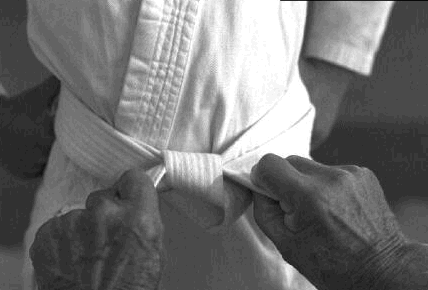
|
| The journey of 1000 miles starts with the frist step! |
It's more than kicks and punches!
There is far more to the practice of Kempo than simply being
able to perform good techniques & kata. The members of our school are also members of society and even as they behave
themselves as martial artists within the dojo, so they are expected to conduct themselves with outside the walls
of the dojo. In order to guide you in what is expected of you, one should
learn the following and apply them to your daily lives. Be obedient
to your parents and elders .Show respect for instructors and senior
ranks. Do not boast of your skills and abilities .Exercise self control. Share your knowledge with others students
of the arts .Take responsibility for your actions.
To Tell, Or Not To Tell ?
I prefer to keep advertising to a minimum, relying on the good reputation of my Dojo as a means of
generating interest . We see advertising as a way to educate the public about our dojo. You are my best form of advertising.
New students are always welcome, but the most valued students are the students I already have! There is no greater compliment
then for a new student to inform me that he was referred in by another student or happy parent. In my mind the existing students
are themselves enthused enough about their dojo to want to spread the word .
Thanks to all those who have supported our dojo over the years making us one of the area's best Martial
Arts Schools. Your continued support helps to ensure the future of Ping Shen Tao for generations to come.
LIKE THE BONSAI KEMPO IS
ALSO LIVING AND GROWING
MIND, BODY, & SPIRIT
Your training in Kempo can function as a road to your
own self-knowledge, providing you choose to use it so. When you train you have a choice. You can train your body, or you can
train your mind and your body. In the first case you'll obtain benefit by becoming healthier and stronger. But by approaching
your training with focus on your mind and body, by constantly questioning, as well as challenging, the different aspects of
yourself, that's how you can acquire self-knowledge. And by doing so, your training can help you along the road to success
of the most meaningful kind. "To know others is wisdom, to know your-self is enlightenment."

Kata
Whether a one student or an entire class in unison
does the performance, Katas are used to demonstrate the skill, knowledge and discipline of the student. Sometimes referred
to as "forms", Katas are a series of techniques put together to tell a story or re-enact a defense situation. They were
developed for use as a training tool and are a cornerstone of the learning process. Students learn movements or
sequence of multiple movements to perform Kata.There are thirteen for first deg. black belt. Many have hidden self-defense
techniques. There may be as few as ten steps, while others may contain hundreds. Try to wake up to your katas, its a
great way to get the day started .
BONSAI!
(Bon) meaning: shollow tray & (Sai) meanning: plant
It is as important to find the time in life for yourself as it is to find it to help others. We must
try to learn another art in life besides your martial ones. As cliché as
it may sound, Bonsai is one of the arts I have had much luck with. Bonsai is the ancient art of planting trees
into shallow pots. It was originally invented by the Chinese (and Egyptians) and was brought to Japan by Buddhist monks centuries
later. It was in Japan that Bonsai became the art form that it is recognized as today. The Chinese were (and are) very much
into animal-like forms, and unnatural shapes which make their bonsai very unique. The Japanese then turned it into
a hybrid between sculpture and holticulture where the object is to harmonize with nature, working with it, not overpower it.
In the 1920's, bonsai began making it's way into America, but really didn't begin to take off until the 1950's.Today,
Bonsai is growing at a great rate and new enthusiasts are being turned on to bonsai everyday.

THE MISSING LINK
The link with the body &
mind has been known in asia for thousands of years but, when it comes to health, our approach in the U.S. has focused
on the physical and the identification and reduction of disease rather than on the promotion of overall well being. We are
now starting to view mental fitness in the same way as physical fitness. We now know that we need to exercise our minds
just as we need to exercise our bodies. We know as well that our mental and emotional health has a powerful impact
on our physical health and visa versa. The martial arts has has helped pepole with their overall health
for thousands of years and will keep on doing so for many more, as the arts are alive and well in the U.S. and growing
everyday!
MORE OR LESS
Once there was a farmer who owned an old mule. The mule helped
around the farm pulling carts and doing chores. The mule had been with the farmer for a long time and after years of hard
work he decided to let the mule just hang around and not work anymore. The farmer would run into the mule once or twice a
day and watch him just hanging around enjoying his days. One day, the farmer did not see him anywhere, he worried about his
old friend. After hours of searching, he finally found the mule stuck in an old well. The farmer tried and tried to get the
mule out, but the well was too deep and he had no equipment around to help him. After awhile the farmer began to think to
himself. "This mule has had his time and maybe I should just bury him right here in the well." So he grabbed his shovel and
started throwing soil on top of the mule. But with every shovel full, the mule shook his back and dumped all the soil under
him. The farmer kept pouring the soil in the well, with the mule shaking it off his back until there was enough for the mule
to walk out of the well.
Some say, a teacher can give a student to much, but I think
all my techniques, lessons, and experiences could be like the soil I am shoveling on top of my students. They can choose to
get buried with it, or to use it as a stepping stone and climb out of their own wells.
THE GAMES WE PLAY
WHILE MANY MAY SAY " TOURAMENTS ARE NOTHING BUT
A WASTE OF TIME " I FEEL THE NEED TO LET MY STUDENTS KNOW THAT THERE ARE MANY THINGS THEY CAN LEARN FROM GOING TO THEM". TO
SEE ANOTHER MARTIAL ARTIST GOING AS HARD AS THEY CAN , DOING THEIR VERY BEST IS VERY THING THAT I WANT TO SEE, TO FIND A BENCH
MARK FOR MY OWN TRAINING. THERE ARE MANY MARTIAL ARTIST THAT HAVE THE SAME THING IN MIND AS YOU, " JUST TO GET MORE OUT
OF THERE TRAINING" THAT IS NOT TO SAY THAT I THINK POINT SPARRING IS A GOOD WAY OF DEFENEDING ONE'S SELFON THE STREET. STREET
COMBAT IS A TOTALLY DIFFIRENT ANIMAL AND IS SOMETHING THAT IS HARD TO INCROP. TO A FREE SPARRING. WITH OUT THE USES OF LOW
KICKS, JOINT LOCKS, ELBOWS OR TAKE-DOWNS IT IS HARD TO SHOW ALL OF YOUR ART, BUT IF YOU CAN STILL PRIVIL WITH ONLY SPEED,
AGILITY, GOOD TIMING AND THE LUCK OF THE JUDGE SEEING YOU HIT HIM, THEN YOU WILL HAVE A GOOD TIME.
1. Bow before going on the floor where you will perform
2. Enter ring from your left to right when facing the judges at the point
you get to the center judges line turn to him and walk towards him w/ hands in hiken . (Kempo hands)
3. Stop when you have come close enough to speak to all three judges and
greet them w/ bow (to all three).
4. Greet with the time of (day i.e. good afternoon judges) and introduce
yourself.
5. Tell them the name of your school and Sensei.
6. Tell them the name of the form that you would like to perform for them
and wait for their permission.
7. Step back to the starting point for your form and go!
8.After you finish be still and give them time to give the scores to the
scorekeeper first and the you.
9. Bow to the persons that have given your our score ( all three) .
10.Walk out of the ring the same way you came in bowing before you step
off the floor of the ring .
EVEN THE BEST MARTIAL ARTIST IS ONLY AS GOOD AS THE PEOPLE HE OR
SHE IS AROUND THAT IS WHY IT IS IMPORTANT TO SEE OTHER MARTIAL ARTIST IN ACTION AND WHAT BETTER PLACE TO DO THAT THAN AT A
TOURNAMENT.
THE SON'S WORDS
"What I really want is for all kenpo people to look deeper into the art than just self-defense techniques
and fighting. You see, after my father retired, some students of kenpo liked to train very hard at the school. They were very
intense about the physical and technical aspects of the art. To find out if the techniques was useful or not they used to
get into several fights every day at bars, theatres, et cetera. This is what gave kenpo and other systems developed from my
father's method such a violent reputation. This made my father very sad. I expect kenpo practitioners to incorporate the kosho
philosophy into their styles. It's not a matter of changing the technique but rather the attitude and the philosophy."
"Many people think of my father, James Mitose, as a mysterious figure who taught early kenpo practitioners
how to punch and kick in the kenpo way. I really do believe that all his teaching boils down to one single principle which
is the essence of kenpo live an ethical life, do justly, love mercy, and walk humbly with God. All the techniques, katas,
forms, and strikes are just tricks."
MASTER THOMAS BARRO MITOSE
| A Black Belt is eraned with alot of hard work |
|
| Can you bear it ! |
BEAR FOOT
Why train barefoot? This is a question that I get all the time. To say that,"to train without shoes
is traditional" may be the best thing I can say about it . The origins of bare foot training started when men of the culture
and period did not were shoes there for it made sense to train in bear feet to make it more realistically for self defense
If those same men where training today I think they would wear shoes. Ask your self this, how many times do you go outside
in your bare feet? (Having said this now I still like to take off my shoe and train 1 or 2 times for every 10 times I train.)
There is much to be said for training in a nice pair of Pine trees or Asics Gels, they are made for martial artist and give
good support for your feet . Odds are it is what you will have on if you do have to defend yourself or your loved ones out
in the real world. So give shoes a try ,It may take some getting use to at first but after some time you will feel
great .
Sonny Gascon, "Father" of East Coast Kempo
This is the story of one of the original developers
of modern kempo- Sonny Gascon. His contribution to the system lives on in possibly more kempo stylists than will ever be known,
largely because they themselves don t know the history of their root. What has kept this story quiet for all of these years
is this Master's own desire to remain anonymous and not add to the historical and still present conflict which reigns among
varying kempo groups. kempo's history has long been filled with unique, if not incredible stories. The development of this
Martial Art is bursting with tales of infighting, migration, development, and unique personalities. Almost all of the founders
in one way or another have been involved in some sort of dispute or controversy which spurred them to go out on their own.
The most remarkable result from all of this is that we now have multiple forms or methods of kempo, all of which seem to have
benefited the system as a whole.
This article will address the migration of kempo to
the East Coast of the mainland U.S. which occurred partially in the 1950s, and most strongly in the very early 1960s. However,
we must first look at the development of kempo from Hawaii.
Any dedicated student of this Martial Art will be
able to tell the legendary story of James Mitose, heir to his family's system. Mitose, born in Hawaii returned to Okinawa at an early age
to begin learning the way of his family. Returning to Hawaii, Mitose is said to have been greatly affected by the wartime
strife between the Japanese and the U.S. As a result, he became one of the very first Asians to open the doors to the Caucasians
known as haoles. Additionally, it appears that Mitose pioneered the way for allowing women to enter the Dojo and begin training.
Although his training was harsh, his training scheme and severity was no match for the brutal ways of many of his local students.
As seniors of the school, their idea of training was very physical, and many times very bloody. They were always eager to
learn anything and everything that was available - both in Mitose Sensei's school and outside. This openness developed by
Mitose led to a diverse student population, made up of all races of Asian and non Asian descent. This was a very unique situation
which was all but unheard of on the island of Oahu. Previous to this, Chinese trained with Chinese, Filipino with Filipino,
and Japanese with Japanese. Those who were left, mainly "haole" trained with whoever was available. As previously stated,
Mitose's school began the breakdown of these barriers. What few could see at that time, is that this breakdown formed the
root for kempo's diversity and effectiveness. Somewhere around the age of 30, William
K.S. Chow decided to go on his own. He had been an instructor under Mitose, although not the most senior.
With him, he brought a young Hawaiian born Filipino by the Name of Adriano Emperado. This was done not as an offensive act
toward Mitose Sensei, but with his permission to assist in the spread of the arts of self defense. Chow was very wise in his
selection, for he had chosen one of the most dedicated and most skilled of the students. Emperado brought with him a vast
knowledge of the Filipino Arts, kempo, and most importantly the knowledge of the streets. Emperado soon took over the main
instructional duties of the school as was appropriate to the time. He established a very tough and brutal regimen which few
could last through. Whenever the students felt that they had enough, enter Master Chow to deliver the required beatings. This
group soon became legendary throughout the islands, and many would come and seek instruction. However, few would last. Another
significant influence at this time was "Nonoy" Emperado's younger brother, Joseph. Virtually unknown, Joe also added significant
aspects in the development of Kempo. Joe essentially became the stand in for Adriano when Master Chow, and his older brother
were unavailable.
During his training time with Chow, Adriano Emperado
continued consorting with Martial Artists of all types and styles. He soon began a fastidious friendship with Joe Holk, Frank
Ordonez, Peter Choo, and Clarence Chang, each an expert in a particular Martial Art including Korean systems, Kempo, Chinese
Boxing (Kung Fu), Judo, Jiu Jitsu, and the Filipino arts. Meeting daily for three years, these young men in their early 20s
would continue to evolve their Kempo to the point where it began to implement and employ empty hand leg and trapping technique
of many systems. These were men of multiple backgrounds, representing the ethnic skills from many sources. Remember, at this
time to reveal the martial secrets of one's race was almost considered blasphemous. However, this did not hinder these brave
pioneers of the Martial Arts and they formed the first Kajukembo "Black Belt Society" which exists to this very day Their concern
and challenge was defining a Martial Art to beat all Martial Arts. Their principle belief was if you trained to beat the Martial
Artist, the street was no problem. Because of his level of skill, coupled with his dominant personality - "Nonoy" Emperado
was elected as the leader of the group. In addition, Emperado wished to make this new evolved Kempo available to the general
public. All students would be welcome, as long as they could tolerate the initiation and training.
Emperado began training students in the Nuanu
YMCA. Later he would establish the KArate, JUjitsu/JUdo, KEMpo, and Chinese BOxing (KAJUKEMBO) Self Defense Institutes. Although
kempo, Emperado's methodology soon became known as KAJUKEMBO to distinguish it from the rest. Emperado adopted the wearing
of Black Uniforms to distinguish his students from the other traditional Martial Artists of Hawaii. Those early years produced
a line of Black Belts which would influence the Kempo world as no one could ever imagine. Among the early pioneer group were
Marino Ttiwanak, Sid Asuncion, Tony Ramos, Walter Godin, Joe Halbuna, Sonny Gascon , John Leoning, and others. The art soon
spread throughout Hawaii and became known as the most vicious practice of self defense on the islands. Emperado's favorite
saying during these years "the training isn't over until there is blood on the floor." Among the early students to begin spreading
to the mainland was Sonny Gascon. Sonny, born in 1933, was the son of a Filipino sugar cane worker who came to Hawaii in 1926
in search of prosperity. While Victor was a child, his father ran chicken fights in the back yard. There
always were several old and young Filipinos which could be seen playing sticks during breaks in the fights. Victor especially
remembers them showing the "dancing" footwork and empty hand applications. As a child, he thought they were just playing,
but later he learned that this was serious martial arts and developed an interest in learning what he could from these secretive
Masters. Sonny had an uncle by the name of Bernard who was a fairly renowned martial artist who began the education of the
younger Gascon. All of them lived in two houses side by side, one house having 9 bedrooms and the other 3 bedrooms. Due to
close proximity of the family, and the large size, an education in the Martial Arts of some sort was always available. In 1945 , Sonny began the study of Judo from KAMAKUDO and "Rubber Man" Tagami at the local Japanese church. He studied
Judo for 3 years form 1945-1948 in NOWANII eventually receiving first level certification. In the early 1950s, one of his
neighbors by the name of John Leoning began Sonny's introduction the kempo system. Henry Papa, Julian Blacquerra, John Leoning
and Sonny would spend days training in this system. Although not called by the current name at that time, they later would
find out it was the Kempo of KAJUKEMBO. Since Victor was the smallest, it became very advantageous for him to become a quick
learner to escape the inevitable outcome. Sonny's training would last about 4 years until he left for the mainland and enlistment
in the U.S. Air Force. 1952 found Sonny Gascon attending basic training at Lackland Air Force Base. Later he attended advanced
training at Fort Belvoir, Virginia. During this period, he shared his Martial Arts with his new found Air Force friends, and
obtained a slight following of students. Although this fact has remained unpublished to date, it is one of the most significant
occurrences in the history of kempo and Kajukembo - this was the birth of these arts on the east coast!
Later Sonny Gascon was assigned to the war zones
of Korea attached to the 51st Fighter Squadron "Checkerboards." While assigned to the war area, Sonny became close friends
with a local Korean houseboy. As a result, Sonny was introduced to the boy s Grandfather who began teaching him Korean and
Chinese principles of Martial Arts. Since this training pre-dated the arrival of Tae Kwon Do, the system was one of soft,
smooth movement more attributable to the Chinese Kung Fu Arts than anything Korean.
In 1953, Sonny Gascon was assigned back home to Hawaii. He quickly resumed his Martial Arts studies with
the local boys of Kalihi. In 1956, he was discharged from the service and decided to move to Pasadena, California. Having
grown up on the same block as Edmund Parker, Sonny renewed his friendship with this young Martial Artist, and the two would
meet and exchange technique, along with celebrating many Luaus in the warm Pasadena climate. Later in 1958, John Leoning came
to California and asked Sonny to become an instructor at the school he would be opening. One evening,
while working out, 3 Hawaiian instructors from home came to the school. The word was given to John Leoning and Sonny Gascon
that they could not use the name "KAJUKEMBO" or the Kajukembo patch since they were not paying a required percentage to the
home school in Hawaii. Sonny's response to this was to invite the Black Belts in for a "work out" - an invitation which they
refused claiming that they were just passing a message along from home. This began Sonny Gascon s departure from the traditional
Kajukembo system and his journey to become independent of Martial Arts politics. In 1960 Sonny Gascon removed the Kajukembo
patch from his uniform and replaced it with the patch of the KARAZENPO GO SHINJUTSU. It was not by coincidence that
the patch bore the image of Daruma, the founder of all Martial Arts. This was because Sonny subscribed to Daruma s favorite
saying "to fall seven times, to rise eight, life starts from now" - Sonny was beginning something new. Since Sonny grew up
in the Kalihi district of Hawaii, he was well known among all kempo practitioners of that time. One of his neighbors, and
close friends would eventually become very famous and begin his own system - namely, Edmund Parker. Because of Sonny's close
associations, he was able to continue obtaining the best knowledge from the myriad of stylists now in California. In those
days, Sonny became legendary in the Los Angeles area and was frequently called upon to demonstrate kempo in early television
shows, and Screen Actors Guild function. Sonny even made a guest appearance an performed a kempo demonstration during a 1961
Dick Clark s American Bandstand. Sonny Gascon was one of the few asked to officiate at the first Ed Parker Internationals,
where Bruce Lee performed his famous one inch punch and Martial Arts demonstration. Later, Sijo Gascon
summoned his Brother-in-Law, Walter L. Niakala Godin, from the islands to help him run the school. During this time, Sijo
Godin became a frequent sparring partner for Ed Parker's most famous student - Elvis Presley. Legend has it that Walter Godin had to be very careful not
to unleash his true skills and hurt the "King of Rock and Roll"! Sijo Godin later founded Godin s Chinese kempo which
exists to this day and is the only Kajukenbo school remaining in the Palama settlement of Hawaii - the founding place of Kajukenbo.
Sijo Gascon returned to his native Hawaii in 1969, but not before leaving a legacy of kempo which lives
even to this day. Sijo Gascon is the person who brought the kata, combinations, and techniques now seen in many styles of
kempo throughout the United States. If you are familiar with Kempo/Kenpo descriptions such as 1 through 5 Kata, Statue of
The Crane, Combinations 1 through 26, etc., then you are a direct descendent of Sonny Gascon. Many systems such as Fred Villari's
Shaolin Kempo, Master's Centers, United Studios of Self
Defense, and Masters of Karate dojos), and even portions of Professor Cerio's Kenpo are either directly or indirectly linked
to this unknown Grandmaster. To this day, it is thrilling to see these forms on old film performed by the Grandmaster himself
over 40 years ago.
Sijo Sonny Gascon is still very much alive and
active today. Recently, he made his first visit to a mainland school since leaving in 1968. This visit was even more exciting
in that he was accompanied by Sijo Walter Godin. Sijo Gascon had asked that this first visit remain somewhat quiet since it
had been many years, and he wished not to offend anyone, however present for the visit were Professor Nick Cerio, Sigung Paula
Pucino of Rhode Island, Master Bruce Corrigan of Virginia, Master Joe Shuras of Massachusetts, and Black Belts from around
the U.S. including William Peterson (Virginia), Rafael Perez (Florida), Kathy Shuras (Massachusetts), Lou Faralan (California),
Dennis Ocampo (Virginia) and Tony DeLalla (Florida). The visit included a tour of the United States Naval Amphibious Base,
home to the U.S. Navy SEALS, and a tour of the largest Navy Base in the world as a guest of the Naval Station Logistics Officer
and special forces members Shawn Riqueleme and Marty Riggs. Later, a testing and demonstration was conducted for the three
greatest living treasures of Kempo - Sijo Gascon, Sijo Godin, and Professor Cerio.
Never had there been this much experience and history alive in one area. Sijo Gascon remarked that he was surprised to see
his method of Kempo - Karazenpo Go Shinjutsu - so alive and flourishing in students everywhere.
A Great Read
Kenpo, sometimes known as "kenpo karate" or "Chinese kenpo
karate," has developed into one of the most popular martial arts in the United States, which itself is remarkable for a fighting
art that came to the United States from Hawaii only a few decades ago.
Kenpo was taught by Professor William Chow in Hawaii and
crossed over to the mainland with distinguished students such as Ed Parker, Adriano Emperado, and Ralph Castro, where the
art has become modified slightly within each school that teaches it. Some schools have added judo throws and jujitsu locks
to the art. Others have brought more of a Japanese and Okinawan influence to kenpo, giving it the solid stances and linear
attacks of a karate system. One of Chow's students, however, has maintained kenpo in the same manner that Chow taught it.
That person is Ralph Castro, a high-ranking black belt in kenpo, who at his Daly City, California, kenpo studio is teaching
"Shaolin Kenpo," a form of kenpo that he maintains is the unchanged, true kenpo as taught by Professor Chow.
Castro first studied with Chow in 1955 and has periodically
returned through the years to Hawaii to train with him. His bond with Chow is so strong that Chow, at age sixty-seven, is
retiring and coming to California to live with the Castro family and serve as an advisor at the Castro kenpo school.
Chow has recently requested that Castro change the name of
the system from "kenpo karate" to "Shaolin Kenpo." Chow's own previous training included ten years of Shaolin kung-fu, and
he originally intended kenpo to contain only Chinese stances and techniques, rather than those of Japanese or Okinawan style.
He developed kenpo as an American offshoot of kung-fu, designed to blend with modern self-defense demands, but still remain
a traditionally Chinese art. Hence the new name, Shaolin Kenpo. He feels that placing the emphasis on Japanese and Okinawan
influences, as some have done, has markedly changed his original concept for the art. Shaolin Kenpo is described by Ralph
Castro like this: "Just as it is possible to use a gun for many different purposes--target shooting, hunting, or law enforcement--Shaolin
Kenpo has always been structured to serve many different purposes such as sport competition, self defense, and to include
the offensive movements necessary for a well rounded fighting system."
To the trained eye, it does look a 1ot more like kung-fu
than other kenpo systems. There are a lot of long-range hand strikes that remind the observer of some kung-fu systems, instead
of the short-hand, inside fighting techniques often associated with kenpo karate. Shaolin Kenpo techniques rely on a great
amount of speed and power, coupled with the idea that instead of having only a one-two punch-kick combination, the student
learns five and six-combination strikes. The theory is, "If you miss, you don't have to stop and regroup," according to Castro.
The end result would be the ability to launch a series of five or more strikes, directed at more than one attacker, in lightning-fast
sequence. Castro's feeling about the use speed in Shaolin Kenpo is summed up thusly: "To be prepared to defend yourself in
a street situation against more than one attacker, you must be able to use a lot of speed with your attacks. In that respect,
speed becomes more important than power, but as the student gains speed and accuracy he also gains power in his punches.
The differences between Shaolin Kenpo and other kenpo Systems
are immense. The Stances are unmistakably Chinese. The Shaolin Kenpo student moves quickly and lightly in the manner of the
Chinese arts to avoid the attacker's onslaught altogether, rather than apply the Japanese tactic of meeting attacks with a
solid frontal defense. The Shaolin Kenpo student frequently circles quickly, continuously bombarding his opponent with an
onslaught of blows calculated to find or create an opening in the opponent's defense. This type of attack is characteristically
Chinese and completely unlike the Japanese and Okinawan concept of a more straight-forward, harsher, and angular push-pull
block and punch combination.
The foot techniques used in Shaolin Kenpo also bear a strong
resemblance to those used in kung-fu. A straight front kick is frequently used, often in the form of a kick to the opponent's
groin. Side kicks are also popular, here again not so much to the head, which would complicate balance, but lower, directed
more at body targets. On the other hand, the popular roundhouse kick is not emphasized in Shaolin Kenpo. Castro admits to
a little creativeness with his art, in that he has borrowed from the karate-based arts the spinning back kick. He likes it,
not only because of its attractive, flowing appearance, but also because of its speed and potential effectiveness.
The kicks are applied in conjunction with the hand movements,
thereby breaking the opponent's concentration on the hand strike or kick that could end the fight. This follows the Chinese
way of thinking punches and kicks performed in conjunction with one another lead an opponent to expose himself while attempting
to block one part of the combination.
The Shaolin Kenpo stylist also uses a wide variety of sweeps
and leg blocks in his art. The sweeps include the low, 360-degree circle and the short, kick-like sweep--both are used to
knock an opponent off balance. The leg blocks are also performed in conjunction with quick hand movements.
The emphasis in kenpo is generally on hand techniques, and
Shaolin Kenpo is certainly no exception. The only difference is that Shaolin Kenpo places the emphasis on kung-fu types of
hand movements. Although the system has closed fists (such as the straight punch and the backfist common to karate, kick-boxing
and kung-fu), it leans heavily toward strikes imitating the animal forms so popular in kung-fu. The animal fighting forms
are not usually part of Japanese or Okinawan fighting systems. Shaolin Kenpo contains a liberal amount of techniques based
on the tiger, eagle, leopard, and dragon styles, again, with all of them bearing strong resemblance to certain Chinese martial
arts.
One interesting difference between Shaolin Kenpo and karate
is that the fighter's guard hand is not kept at his hip to facilitate the "push-pull" action so common to Japanese systems.
The guard hand is always kept in a circular protecting position in front of the body, as in most Kung-fu styles. This is a
basic difference in philosophy, because the kenpo fighter, instead of relying on the kind of power developed by the push-pull
hand techniques, must utilize his speed, agility, and quick footwork to evade, counter, and return the attack. This marks
an important difference in theory between the Chinese and Japanese schools of thought.
Unlike a boxer, the Shaolin Kenpo stylist does not at any
time stick or grapple with his opponent. He will, however, block the attacker's blows in a manner that "sucks in" his opposition.
He will be trying to render his assailant off balance, and one method of doing that is to pull him into range of the kenpo
stylist's barrage of blows.
The hand strikes in Shaolin Kenpo are much more circular
than linear, as in the karate oriented systems. The arm motions are usually sweeping, long-range attacks allowing the Shaolin
Kenpo practitioner to simultaneously block and attack. Remember that in order to fully utilize these circular hand movements
he must be able to change direction quickly and smoothly. This emphasis is also very Chinese in character.
The method with which Shaolin Kenpo is taught constitutes
another difference between that system and other styles. Castro introduces the student to some very quick effective combination
techniques from the student's very first day in the studio. In the beginning, there are no basics taught, just these techniques.
Along with those techniques, Castro teaches the practical application and stresses development of speed. The new student gets
an idea of the coordination between hand and footwork necessary in Shaolin Kenpo. After learning those initial combination
techniques, the student is then taught the basics of the system. This foundation is something that he will be expected to
constantly refresh himself in. One advantage of learning the important basic theories (such as speed and focus) of the system
before learning the basic stances, hand strikes, and kicks is that the new student can immediately start to apply those concepts
to the basics as he learns them. That way he gets the confidence and idea of how to effectively use what he is learning, even
as he learns it.
Castro refers to the forms taught in Shaolin Kenpo as "sets,"
as in kung-fu terminology, instead of using the Japanese term "kata." The sets are designed to teach the student how to apply
the techniques that he has learned, as well as to practice his form, speed, and balance. Shaolin Kenpo does not use the sets
simply to practice the basics of the system, but makes them into practical flowing forms designed to simulate counters and
attacks against many attackers. These sets are designed to be practiced either alone or with another kenpo stylist. Not only
does Castro have his students practice their sets with an actual antagonist, but the sets themselves are structured to he
used as the defensive or offensive counterpart to other Shaolin Kenpo sets. This means that a student might want to practice
a set called "circle of iron" with another student, and the other student would use another kenpo set as the defensive side
of "circle of iron." Here again we have a situation that tends toward the kung-fu philosophy of the need to have two-man sets
to teach focus, speed, and quick reactions.
The sets are structured to teach an important principle or
technique to the kenpo student. The first set is titled "mountain meets river" and the student learns to he as strong as a
mountain and to flow like a river. From there he progresses to sets such as "high river" where he develops strength and balance
in his legs, and "river dam" where the student learns how to react when backed up against a walk. The animal forms come when
the kenpo student has thoroughly assimilated the basics of the system. At that time he will start learning sets like "eagle
flys low"; "fire dragons"; and "galloping horse." These are all advanced sets designed to be used by the student who already
has developed his confidence, speed, and power. Not only does the student use his forms training alone and against a partner,
but he takes portions from his sets for use in tournament fighting. This links the practical applications of the techniques
with the fighting movements derived from the forms.
This, according to Ralph Castro, is kenpo the way that Professor
Chow intended it to be. Certainly, a lot of credence is lent to his statement by the fact that Chow is coming to live with
the Castro family, and will have an opportunity to further show his kenpo to the mainland public. It is Chow's primary concern
that kenpo should be kept simple, direct, and traditional, and Shaolin Kenpo appears to fill that desire.
About the author: Jane Hallander is a freelance writer
from the San Francisco area who has studied both kenpo and kung-fu extensively.
|
 |
|
|
|
|
Enter content here
|
|
|
Enter content here
|
|